When Actors Are No Longer Human: The Intellectual Property Dilemma of 'AI Actors'


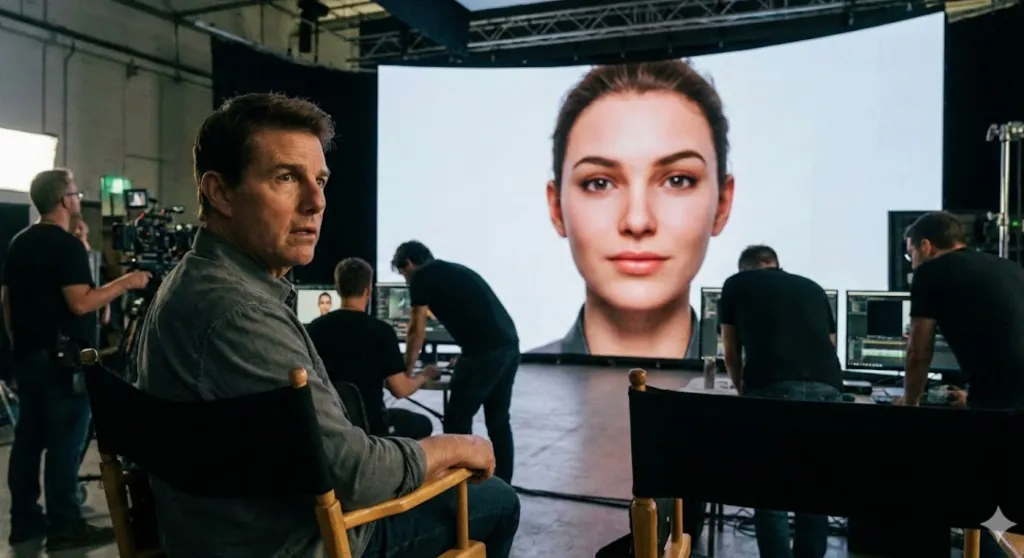
Taiwan’s AI Basic Act was passed earlier this year, establishing that AI research and application should possess “transparency and explainability,” and declaring principles such as “AI training and output should protect intellectual property rights and people’s property rights.” However, when these principles meet practice, specific legal gaps begin to emerge one by one. Taking the recently controversial “AI actors” as an example, Xicoia—a studio founded by actor and producer Eline Van der Velden—introduced an AI character named “Tilly Norwood” and publicly expressed intentions to launch her into Hollywood, immediately sparking backlash from many working actors. This article focuses on the intellectual property issues surrounding “AI actors,” analyzing everything from training data collection and model generation to the attribution of rights in their “acting careers,” thereby highlighting the significant gaps in current legal frameworks.
The Legitimacy of Training Data
First, regarding the source of “AI actors”—the legitimacy of training data—current practices in most countries generally recognize the legality of using publicly available online data for training. While the EU allows creators to “opt-out” by indicating prohibition, U.S. court precedents have largely determined such use constitutes “Fair Use.” Since Taiwan’s stance on intellectual property protection leans more toward the U.S., using public data for AI training should fall within the scope of fair use under Article 65 of the Copyright Act.
Attribution of Rights in AI-Generated Content
However, when AI models move from “learning” to “output,” the attribution of rights to generated results becomes another challenge. Compared to human actors who, after performing, can claim moral rights and remuneration for property rights in their works, while retaining portrait rights derived from personality rights, legal practices in various countries tend to deny copyright to AI-generated content. Taiwan’s Supreme Court has explicitly stated that the Copyright Act’s protection is limited to “human intellectual creations,” a view that seems to exclude algorithm-generated “AI actors” from protection. Additionally, since “AI actors” are not subjects of personality rights, they cannot claim portrait rights, leaving the rights status of their “performances” in a vacuum where no one can assert claims.
Compensation Mechanisms and Personality Rights Protection
Facing this dilemma, establishing compensation mechanisms for training data use could serve as one solution to balance the interests of developers and creators. Under the AI Basic Act’s framework requiring “transparency and explainability,” future regulations could require development companies to disclose training data sources, enabling legal authorization or corresponding compensation. However, fundamentally, if an AI character generated through model learning closely resembles a specific real person in appearance and characteristics—to the point where the general public can easily make associations—it remains difficult to avoid questions about infringement of the individual’s personality rights and digital human rights.
Rights Disputes Between AI and AI
Furthermore, current legal difficulties exist not only between humans and AI but also between AI and AI. If a development company generates “another AI actor” that closely resembles an existing “AI actor,” can the former company claim infringement? What would be the legal basis for such a claim? This is also an extended issue for which current legal frameworks have no clear answer.
Learning from Special Legislation
In fact, beyond general intellectual property laws such as the Copyright Act, Patent Act, and Trademark Act, Taiwan also has protection systems designed specifically for certain industries, such as the Integrated Circuit Layout Protection Act and the Plant Variety and Seed Act. Following this, whether it’s possible to reference such “special law” models to establish specialized regulations for AI output is also worth in-depth discussion.
Conclusion: From Principles to Practice
In summary, as AI models and AI actors become increasingly prevalent, current legal frameworks indeed show structural inadequacies in intellectual property attribution and protection of interests for development companies and training data providers. The passage of the AI Basic Act marks a crucial first step in Taiwan’s AI governance; however, from principles to practice, more detailed supporting regulations are still needed for implementation. Whether through amending existing laws, expanding interpretation, or enacting specialized regulations, Taiwan has the opportunity in this wave of global AI development to establish a legal paradigm that balances innovation with rights protection. This is not only a gap urgently needing to be filled in legal policy but also an issue of our times that we cannot avoid.
Further Reading: