Yes, Private Companies Can Build SMRs in Taiwan: What the Premier Confirmed on November 3

A note for investors, energy developers, AI and semiconductor companies, and anyone watching Taiwan’s energy security.
The short version
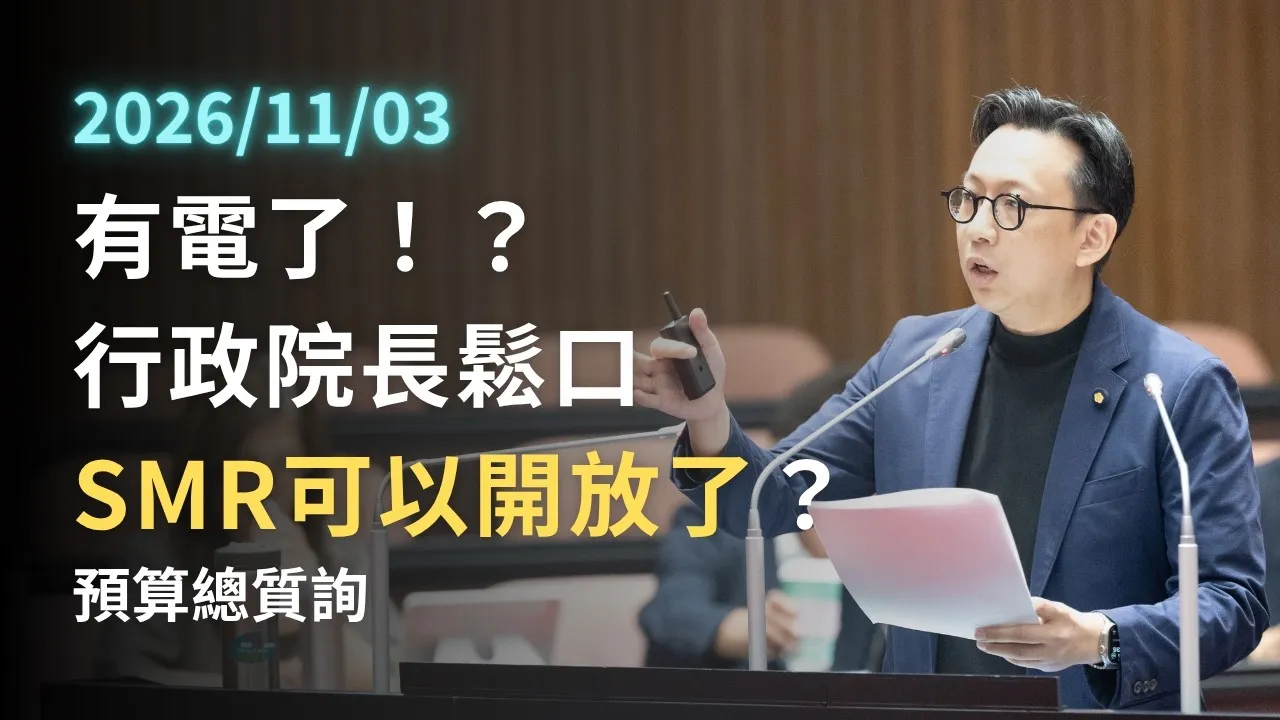
On November 3, 2026, during interpellation in Taiwan’s Legislative Yuan, I asked Premier Cho Jung-tai a direct question: if a major company in Taiwan applies to build its own small modular reactor (SMR), will the government approve it, or is the answer no across the board?
His answer: “We will handle it case by case.”
That sounds modest. For Taiwan, it matters a lot. For months, much of the international community has assumed that private nuclear power is simply illegal in Taiwan, partly because the Minister of Economic Affairs had earlier told the legislature that private parties cannot operate nuclear power plants. That is not what the law says, and on November 3 both the Premier and the Minister acknowledged it on the record.
Here are the facts.
1. What the law actually says
Article 5, Paragraph 2 of Taiwan’s Electricity Act (電業法) reads:
“Power generation enterprises that operate nuclear power generation, and hydropower generation enterprises with a capacity of 20,000 kW or more, shall be limited to public ownership. However, this restriction does not apply where approved by the electricity regulatory authority.”
Paragraph 3 defines “public ownership” as more than 50% government capital, or more than 50% held through reinvestment by state-owned enterprises.
The Electricity Act gives two legal paths for non-state nuclear generation:
- Direct approval. A private operator may be approved by the electricity regulatory authority under the Paragraph 2 proviso.
- Joint ventures. A project in which the government or state-owned enterprises (such as Taipower) hold more than 50% counts as “public” by definition. That leaves room for private capital and technology partners holding up to 49%.
Nuclear safety licensing is a separate track, handled by Taiwan’s independent Nuclear Safety Commission. That track was modernized in May 2025, when the Legislative Yuan passed the first amendment in 22 years to the Nuclear Reactor Facilities Regulation Act. I was one of its sponsors, and as convener of the Education and Culture Committee, the committee that reviewed the bill, I chaired its committee review.
2. What the government said on November 3
From the floor exchange, as reported by United Daily News / Economic Daily News and China Times, and in my own unedited video of the session:
- On the law, Premier Cho said the general rule is that private parties may not operate nuclear plants. He then acknowledged that Article 5(2) of the Electricity Act contains a proviso: with approval from the regulator, it is allowed. He described this as an exception that applies under special conditions.
- On a private SMR application, his answer was “case by case.” The government’s three preconditions for any nuclear project still apply: nuclear safety assured, a solution for nuclear waste, and social consensus.
- On oversight, Minister of Economic Affairs Kung Ming-hsin said the three principles apply equally to state-owned and private operators. The difference is that state-owned enterprises already have a supervisory mechanism, so if the private sector wants to do this, the government may need to design a supervisory mechanism for it.
- On priorities, the Premier said the near-term focus is the restart reviews of the Maanshan (Nuclear Plant No. 3) and Kuosheng (No. 2) plants. Taipower is completing its self-initiated safety inspections, which the Ministry expects to finish by 2028. After that comes “connecting with the world on SMR R&D.”
In short, the door is legally open, and the executive branch has now said publicly that it will not reject applications outright.
3. What is still missing
The government still has no published process for anyone wanting to apply.
No published criteria exist for:
- the financial capacity an applicant must demonstrate,
- the unit size or total capacity thresholds,
- the supervisory regime that would apply to a privately operated reactor,
- how the Ministry’s approval under the Electricity Act would be sequenced with the Nuclear Safety Commission’s safety licensing.
On the floor, I asked the Premier to direct the Ministry of Economic Affairs to draft these approval standards, so that serious investors have a clear process to follow and administrative ambiguity does not become the obstacle. Getting that framework written is my next fight.
4. Why this matters now
AI runs on electricity, and Taiwan builds the chips the world’s AI runs on. Reports this year said TSMC has been evaluating next-generation nuclear options, including asking how advanced-process fabs in the southern science parks could use SMRs. (On the floor, the Minister said TSMC has not raised this with the Ministry directly.)
Global AI companies are watching too. Anthropic’s IPO registration statement (Form S-1, filed with the U.S. SEC on October 26, 2026) says on page 33 that the concentration of advanced chip manufacturing in Taiwan creates significant risks, including:
“vulnerability to any interruption in Taiwan’s power grid, water supply, or other critical infrastructure”
(SEC EDGAR; I walked through this filing in a video.) When the world’s leading AI companies write Taiwan’s grid into their risk disclosures, energy policy stops being a domestic issue.
Meanwhile, the money is going elsewhere:
| Item | Amount (NT$) |
|---|---|
| 2026 supplementary budget, total | ~607.6 billion |
| Subsidies and capital injections for CPC and Taipower | ~414.8 billion |
| 2027 SMR research funding approved for the National Atomic Research Institute | ~118.2 million |
SMR research comes to less than 0.03% of what is going into energy-utility subsidies in a single supplementary budget. The government’s 2030 Energy Transition White Paper plans NT$900 billion for net-zero by 2030, yet it sets no target or timeline for nuclear power at all. For comparison, the United States aims to quadruple nuclear capacity to 400 GW by 2050, Japan targets 20% nuclear by 2040, and South Korea targets 35.2% by 2038.
I don’t oppose stabilizing energy prices for households. But subsidizing after the fact is no substitute for investing in the next generation of energy technology. If we wait until SMRs are fully commercial before starting, Taiwan will be at the back of a very long global queue for reactors, fuel, and talent.
Energy security is national security. For Taiwan, energy security is also AI-supply-chain security.
5. What comes next
- November 28, 2026: Taiwan holds a national referendum on repealing the “nuclear-free homeland” provision. The Premier said on November 3 that the government will be bound by the result either way.
- Approval criteria: I will keep pressing the Ministry of Economic Affairs to publish clear standards for private and joint-venture SMR applications under Article 5(2).
- R&D funding: I will push for SMR research funding that matches the scale of the opportunity.
To international partners
If you are a reactor developer, an investor, a hyperscaler, or a semiconductor company, here is what I want you to take away from November 3:
Taiwan’s law does not prohibit privately built nuclear generation, including SMRs. The Premier has confirmed that applications will be considered case by case. What Taiwan still needs is a clear approval framework, and that is what we are working to build.
My office welcomes conversations with companies and institutions that want to help Taiwan build it.
Sources
- Taiwan Electricity Act, Article 5 (Laws & Regulations Database of the ROC)
- China Times, “企業能擁有小型核反應爐?卓揆鬆口可個案申請 葛如鈞有話說,” November 3, 2026 (link)
- Economic Daily News / UDN, “月底重啟核電公投 卓榮泰:不論通過與否…政府都受約束,” November 3, 2026 (link)
- Full unedited interpellation video, November 3, 2026 (YouTube)
- Anthropic, PBC, Form S-1 Registration Statement, p. 33, filed October 26, 2026 (SEC EDGAR)