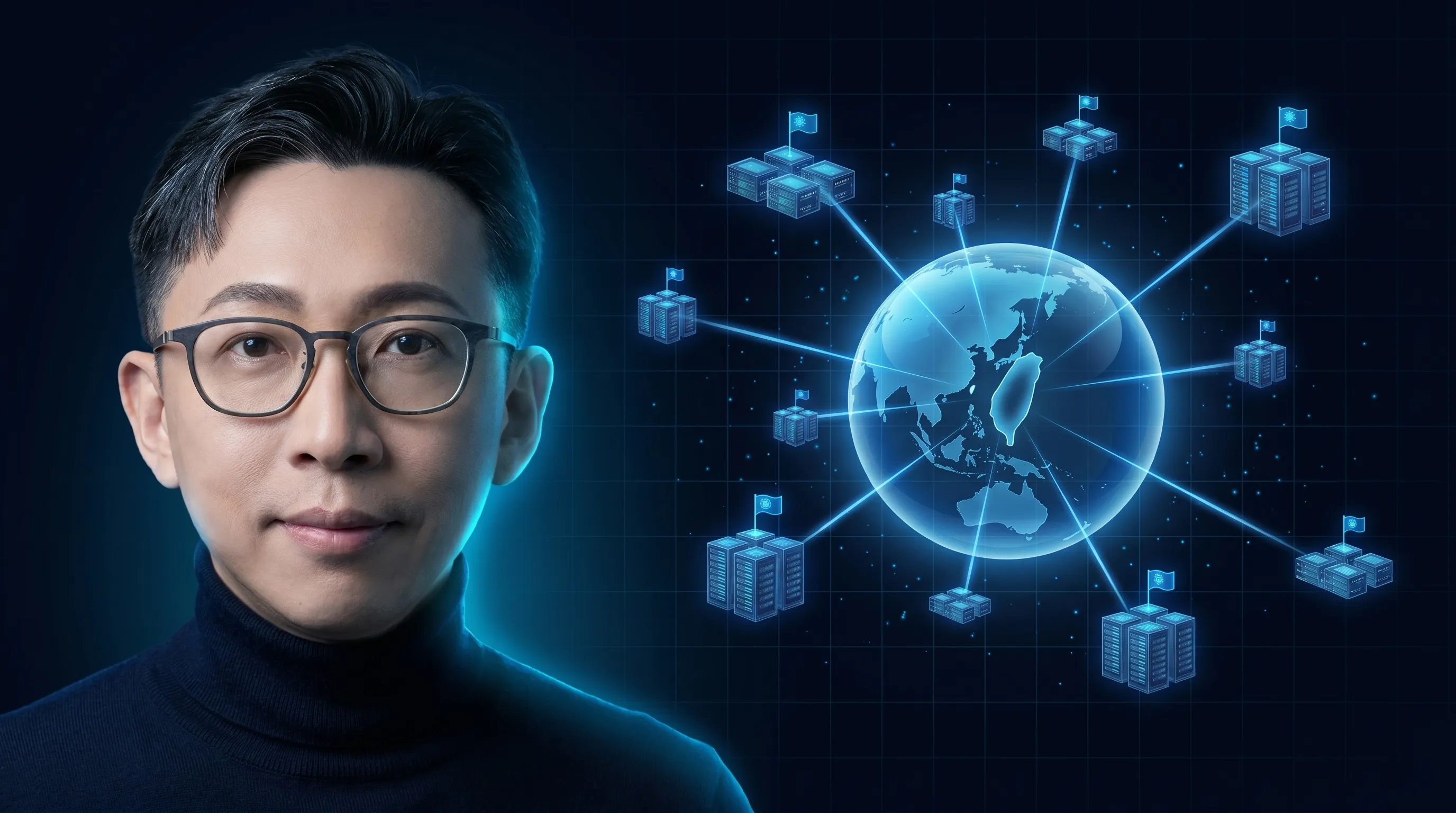
Musk Is Building a 10 GW Fab in Texas. What Does Taiwan Do Now? — Three Proposals: Compute Embassies, Compute Purchase Agreements, and Overseas Compute Satellite Stations

Musk Is Building a 10 GW Fab in Texas. What Does Taiwan Do Now?
“Terafab is much larger than everything Giga Texas has done combined.
We need thousands of acres of land, and more than 10 GW of electricity.”
— Elon Musk, on X
On the evening of March 21, 2026, at the Seaholm Power Plant in Austin, Texas, Musk formally unveiled the Terafab vision via livestream on X: a partnership with Intel using its 14A process, targeting 1 terawatt (TW) of annual AI compute output, with 80% deployed to space — leveraging Starship transport and unlimited solar energy. Only 100–200 GW will remain on the ground.
Two months later, fresh revelations keep dropping. In late May, Hong Kong-based TF International Securities analyst Ming-Chi Kuo named a major Taiwanese IC design house as a likely “key piece” of Terafab; Taiwan’s heavy-electrical names and the broader supply chain are in full advocacy mode; major “high-profile concept stocks” hit limit-up multiple sessions. This isn’t a one-off event — it’s an ongoing global apparatus deployment.
The investment starts at $20–25 billion and could grow to trillions. The 10 GW electricity demand equals ten nuclear power plants. Thousands of acres of land equals 150+ modern semiconductor fabs.
Just reading those numbers takes your breath away. But more important to ask:
When the U.S. has Texas, the ERCOT grid, Starship, SpaceX, and a $1.5 trillion compute investment plan — how does Taiwan plug in?
We don’t lack supply chains. We lack strategy.
🇹🇼 The Brutal Math: Taiwan’s Natural Limits
Let me lay out a few numbers:
| Metric | Taiwan | United States |
|---|---|---|
| Land area | 36,000 km² | 9.83M km² |
| 2024 total electricity generation | ~290 TWh | ~4,300 TWh |
| Solar viable area | Severely limited | Nearly unlimited |
| Wind expansion room | Limited north + offshore | Vast central plains + offshore |
| One 1 GW AI data center | ~3% of national grid | ~0.02% |
| One Terafab (10 GW) | ~30% of national grid | ~0.2% |
10 GW is almost one-third of Taiwan’s national electricity output.
This isn’t a question of whether to build it. We physically cannot.
Our historical advantages — semiconductors, precision manufacturing, talent density — were all built on the “island economy” model: high density, high efficiency, vertical integration. But the physical demands of AI fundamentally conflict with the island economy model:
- AI requires massive electricity; Taiwan’s grid is already stretched
- AI requires massive land; Taiwan’s land is scarce
- AI requires massive cooling water; Taiwan’s water supply is unstable
- AI requires proximity to energy; Taiwan imports most of its energy
We can build the world’s most advanced fabs. But we can’t build the world’s largest AI compute centers.
This isn’t a technology problem. It’s geography.
💡 Proposal 1: Overseas “Distributed Compute Satellite Stations”
If we can’t build large-scale compute on the island, let’s build Taiwan’s compute outposts around the world.
I call this concept Compute Satellite Stations:
🌐 Concept:
Taiwan capital + Taiwan tech + local energy + local land = overseas compute hubs

🎯 Candidate locations:
- Middle East (Saudi Arabia, UAE) — abundant solar + sovereign wealth
- Northern Europe (Iceland, Norway) — geothermal, hydro, free cooling
- Canada, Alaska — cheap hydro + cold climate
- India, Southeast Asia — friendly markets, labor, emerging AI demand
- Paraguay, Brazil — diplomatic allies + hydro surplus

🦴 Structure:
Taiwan provides equipment, technology, operations
Locals provide land, electricity, policy support
This model isn’t entirely new — TSMC is already building in Arizona, Kumamoto, and Dresden. But today we need to extend this strategy from “fabs” to “compute itself.”
Taiwan should proactively pursue:
- National Development Fund / public banks equity participation in overseas compute hubs
- Ministry of Economic Affairs signing MOUs with target countries for land, electricity, tax incentives
- Ministry of Foreign Affairs elevating “compute diplomacy” to formal strategy
- Ministry of Digital Affairs drafting data sovereignty + cross-border compute regulatory framework
⚡ Proposal 2: “Compute Purchase Agreements” (CPA)
This concept borrows from energy.
Over the past decade, global energy transition relied on PPAs (Power Purchase Agreements) — corporations signing 10–20 year contracts with electricity generators to lock in price and supply. Google, Microsoft, and Amazon have built the world’s largest portfolio of renewable energy assets through this mechanism.
Taiwan can pioneer a new financial instrument: the Compute Purchase Agreement (CPA)
📐 Structure:
Taiwan (companies + government) ⟷ Overseas compute provider
                                ↓
                          10-20 year contract
                          Lock in token usage
                          Secure capacity quota
                          Stabilize AI service costs
Three concrete paths:
A. Government-led “Sovereign Compute Reserves”
Like national petroleum strategic reserves, Taiwan should establish a “Sovereign Compute Reserve” — sovereign-level CPAs pre-purchasing 5–10 years of cloud AI tokens for:
- Public-sector AI applications (health insurance, taxation, education, defense)
- Academic research institutions
- Public services (one-stop government, disaster response, transportation)
- Tendered allocation to SMEs
B. Industry consortium “Group Buying of Compute”
Mimicking Japan’s classic “Semiconductor Co-Research Society” model — Taiwanese SMEs collectively pre-purchase tokens from OpenAI, Anthropic, Google, xAI, enjoying scale discounts and shared distribution. This especially benefits:
- Traditional industries without self-hosted AI infra
- SMEs wanting digital transformation
- Boutique software firms and studios
C. Bilateral “Compute-for-Energy Swap”
Taiwan has capital and AI application talent; the Middle East and Nordics have power and land. We can push bilateral agreements based on “equipment for compute”:
- Taiwan exports power supplies, transformers, servers, cooling systems (Taiwan’s tier-1 “duo” — known industry-wide as “the Two T’s” — plus several supply-chain integrators are already global players)
- Counterparty exports energy / land, and shares the resulting compute capacity
- Joint ventures: 50% capacity stays local, 50% reserved for Taiwan
🏛️ Proposal 3: “Data Embassies” and “Compute Embassies”
This is my personal favorite, and possibly the most uniquely Taiwanese.
The old embassies are diplomatic outposts. The new embassies may also be compute outposts.
What is a “Data Embassy”?
Data Embassy: cloud infrastructure in allied or partner countries that enjoys “extraterritorial data sovereignty.” Even if the host country experiences coup, war, or natural disaster, the data remains protected under Taiwan’s laws.
Estonia established the world’s first official Data Embassy in Luxembourg in 2017, ensuring national data survives even if homeland is attacked.
For Taiwan, this concept carries dual meaning:
- Data security: backups of healthcare, household, tax, defense data deployed to trusted allies
- Data sovereignty: when other countries enforce “data localization” (EU GDPR, India DPDP, Indonesia PDP), Taiwanese businesses can operate legally via “local Data Embassies”
Advanced version: “Compute Embassies”
Take it further: build compute outposts in allied countries. Part of the capacity serves locals, part is reserved for Taiwanese businesses — giving Taiwanese companies a free “American IP, European IP, Indian IP” compute backdoor.
This is especially valuable for Taiwanese AI startups:
- Want to serve U.S. market → use U.S. Compute Embassy
- Want EU → use German / Dutch Compute Embassy
- Want Southeast Asia → use Singapore / Indonesia
- Want Latin America → use Paraguay / Brazil
Not just compute — but a compliance passport.
🔧 Why Taiwan Can Pull This Off
Back to Terafab. When Musk needs 10 GW and 150+ fab-equivalents of capacity, he didn’t pick Japan, Germany, or Korea as core partners. He picked Intel (process) + Taiwanese supply chain (power + cooling + assembly).
Why?
Because Taiwan has two world-class players — the industry-known “Two T’s”: one in fab (process), one in power electronics. Together with several systems integrators, heavy electrical equipment makers, precision motion specialists, and machine vision integrators, they form a Physical AI supply chain cluster with no global substitute.
I must emphasize: this article is absolutely NOT investment advice or recommendation.
This article intentionally references companies via code or as collective nouns rather than by name, for three reasons:
- Avoiding any individual stock signal: this is about national strategy, not company valuation
- The industry is still evolving: today’s players aren’t necessarily tomorrow’s winners
- Policy neutrality: as a sitting legislator, naming specific companies could create unwarranted policy associations
What I want to say isn’t whether these companies will make money — but —
They earned their position in Terafab’s supply chain because they started “Made in USA” positioning years ago.
One Taiwanese power electronics giant has a 1.5-million-square-foot facility in Texas with 1,500+ employees;
One heavy electrical company has run its Texas operation for 30 years;
One systems integrator has invested $2 billion in Wisconsin and major facilities in Texas and Louisiana.
None of this was government-led. The industry went out and did it themselves.
So what should government’s role be?
🇹🇼 Five Things Government Should Do
For the past 30 years, government’s role was “don’t get in the way” — let the silicon mountain grow freely.
For the next 30 years, government’s role should be “pave the international path” — make it easier for Taiwanese businesses to expand globally.
Specifically:
1. Establish an “Overseas Compute Deployment Fund”
Led by the National Development Fund, modeled on Singapore’s Temasek — direct investment in overseas compute hubs, negotiating tax breaks with host governments, letting mid-cap Taiwanese companies (NT$10B–100B market cap) also expand globally instead of leaving all the risk to the “silicon mountain” tier.
2. Make “Compute Diplomacy” Formal National Strategy
Like oil diplomacy and chip diplomacy, compute diplomacy should be written into national security strategy:
- Which countries are our compute allies?
- Where should Data Embassies be set up?
- Where can we co-build Compute Embassies?
3. Build a “Cross-Border Data Compliance One-Stop Service”
Stop forcing Taiwanese AI startups to fight “data localization” battles alone — government should proactively negotiate mutual trust agreements with major markets (EU, US, India, SE Asia), or even operate a government-led Data Embassy pilot.
4. Pilot a “Sovereign Compute Pre-Purchase” Program
Reference Singapore’s “Compute Contract Pool” pilot: government pre-purchases large volumes of cloud AI tokens, then redistributes to:
- Public-sector AI (making government smarter)
- Academic institutions (so research isn’t gated by compute)
- SMEs (so traditional industries without IT departments can use AI)
5. Globalize the Energy Strategy
Acknowledge Taiwan’s island energy limits, actively fold “energy diplomacy” into AI strategy:
- Sign “energy-for-compute” agreements with Middle East, Nordics, Canada
- Encourage Taiwanese investment in overseas green energy, supporting overseas Taiwanese compute hubs
- Expand “Made in Taiwan” from “manufactured in Taiwan” to “designed by Taiwan, managed by Taiwan, manufactured globally”
⏳ Why Now?
Because Terafab won’t wait. Stargate won’t wait. xAI Colossus won’t wait.
The past 10 years asked: “Where do we build data centers?”
The next 10 years will ask: “Where do we build compute factories?” — scale jumping from “hundreds of MW” to “several GW” to “tens of GW.”
When the U.S. burns 5 nuclear plants worth of power per year on AI, when Musk launches 80% of compute to space, when Middle Eastern sovereign funds spend tens of billions per year on their own compute centers — Taiwan can no longer just be a supply chain. We must become a strategic player in this global compute migration.
We have the talent, the technology, the capital, the 30 years of manufacturing depth. We just lack a policy framework for “leaving the island”.
Not geographically. Conceptually.
From “island economy” to “archipelago compute network.” From “equipment exports” to “compute exports.” From “silicon mountain” to “compute mountain range.”
🌏 A Metaphor to Close
Taiwan is like a very large ship parked at the edge of the world.
The old ship carried containers, wafers, consumer electronics.
The new ship carries compute, tokens, intelligence itself.We have the best engines, the strongest crew, the smartest captains.
But ships need ports — ports owned by other countries.“Compute Embassies” don’t bring the ports to Taiwan.
They ensure Taiwan’s ship
always has somewhere to dock.
Written in the early hours of May 31, 2026, three days after analyst Ming-Chi Kuo named a major Taiwanese IC design firm as a likely Terafab “key piece”, the day after Taiwan’s market hit a record 44,732.
Technology is redrawing the world map. Taiwan’s policy must not lag behind.
— Ju-Chun KO (BaoBo) / Legislator
📌 Disclaimer
This article is a policy commentary, NOT investment advice or financial analysis.
When the article references industry sectors, it intentionally avoids naming specific publicly-listed companies — even when mentioning industry position or role, it uses “the Two T’s”, “a Taiwanese power electronics giant”, “a heavy electrical company”, “a systems integrator”, and other collective or coded references. This is a deliberate editorial choice for three reasons:
- Avoiding any individual stock signal: this article concerns national strategy and industry trends, not value judgments on any specific company
- The industry is still evolving: today’s players aren’t necessarily tomorrow’s winners
- Policy neutrality: as a sitting legislator, naming specific companies could create unwarranted policy implications
Readers seeking specific company information should do their own research, accept their own risk, and consult qualified financial advisors. Views expressed are personal and do not represent the Legislative Yuan or the author’s political party.