Bring Promises Back to Politics: Why I Support the Presidential Impeachment Case

Today is President Lai Ching-te’s 725th day in office.
Seven hundred and twenty-five days is not an abstract political number. It is the accumulation of daily household expenses for countless families, the anxiety young people feel in the AI era, the risk commuters bear in chaotic traffic, and the long wait industries have endured while expecting the government to fulfill its promises.
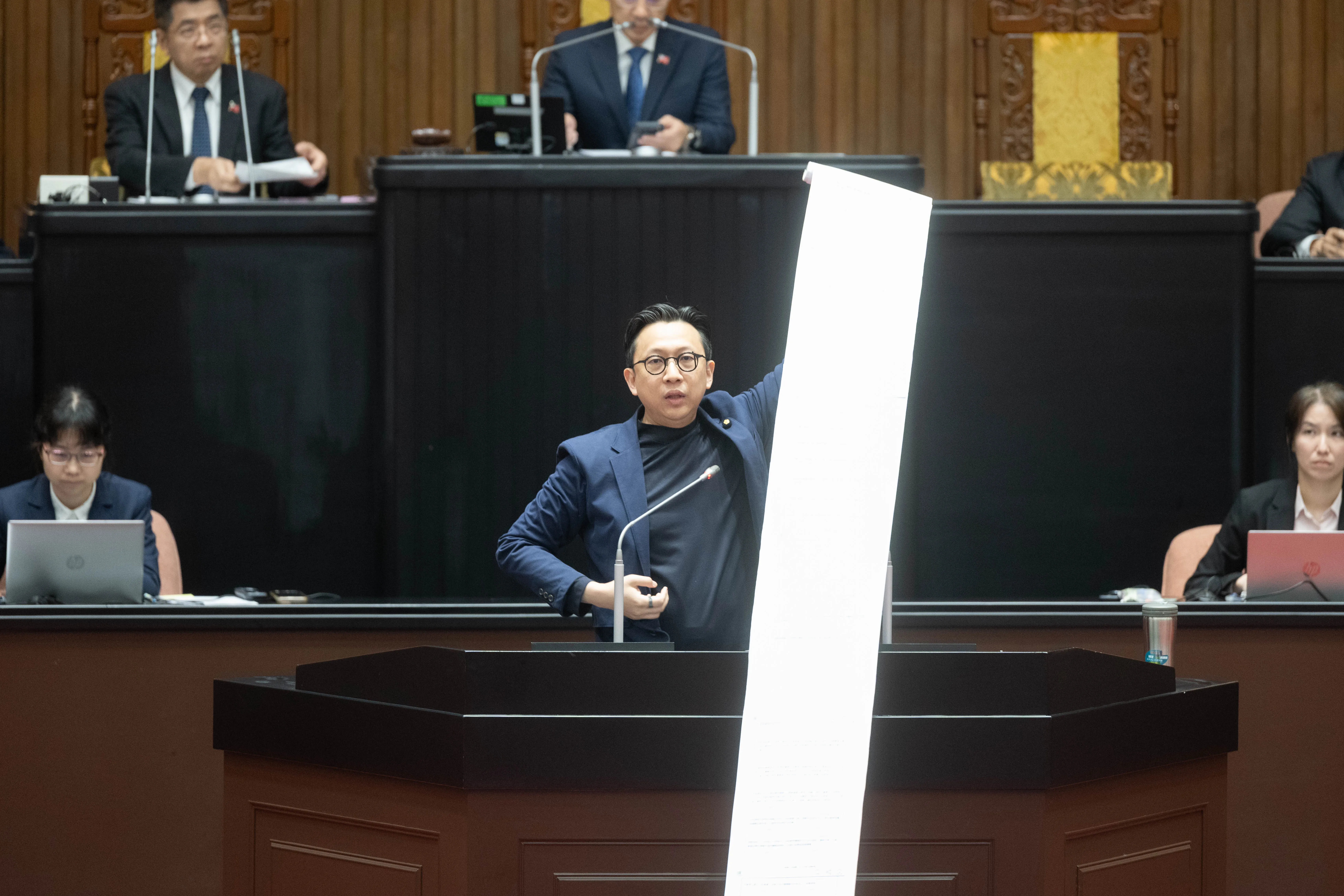
That is why, when the Legislative Yuan’s Committee of the Whole reviewed the impeachment case against President Lai Ching-te, I chose to ask the question directly: during these 725 days, have people’s lives become happier? More secure? More stable?
Promises Are Not Decorations. Power Must Be Accountable.
Campaign promises should not be treated as campaign-season marketing materials. When a candidate gains power through promises, that person must answer to the people through governance.
In my speech, I cited media tracking of President Lai’s 227 campaign promises and noted that very few have truly been fulfilled. Even the three-shift nurse-patient ratio legislation moved forward through cross-party cooperation led by the opposition; it cannot be repackaged as proof that the administration proactively fulfilled its promise.
Trust is the core of democracy. When promises are broken one after another, when people’s suffering is ignored, and when the responsibilities of the state are delayed, the legislature has a duty to stand up and bring the most serious form of accountability on behalf of the people.
Energy Policy Must Not Sacrifice Health and Industry to Ideology
President Lai once promised to build a net-zero innovation technology platform, but Taiwan’s energy structure still relies heavily on natural gas and coal-fired power. This is not merely a question of generation mix; it is a question of national security, industrial competitiveness, and public health.
Energy policy should not be an ideological battlefield. Net zero cannot rely on slogans, and power stability cannot rely on luck. Nuclear energy, renewable energy, storage, grid resilience, and industrial electricity demand must all return to pragmatic, scientific, and responsible discussion.
If the government keeps protecting political sacred symbols while high-pollution and high-carbon power sources remain central to Taiwan’s electricity supply, the final cost will be paid by all citizens and by Taiwan’s industries.
Communications Resilience Is National Security, Not a Minor Convenience
More than 90% of Taiwan’s international internet traffic depends on submarine cables. In normal times, a network outage is an inconvenience. In an earthquake, disaster, wartime, or deliberate sabotage scenario, communications disruption becomes a national-security crisis.
I have long advocated opening Taiwan’s sky so low-earth-orbit satellites and diverse satellite communications services can become part of national resilience. This is not about any single provider. It is about giving Taiwan a heterogeneous backup network in which submarine cables, microwave links, and satellites coexist.
National security is not only about buying weapons. Whether a country can stay connected in a crisis, and whether government, disaster-response units, medical systems, financial systems, and citizens can maintain basic communications, is also national security.
AI Equity Cannot Wait Until Young People Fall Behind
President Lai’s platform clearly promised to actively eliminate the digital divide. But in the AI era, a new divide has already appeared: paid AI tools are becoming more powerful, and the gap between free and professional versions is widening.
When subscriptions to mainstream professional AI tools become a burden for students, young people, and ordinary families, AI may shift from a productivity tool into a new marker of social class.
That is why I advocate AI vouchers and public access. AI should not belong only to those with resources. If the government truly wants people to be able to “use AI,” it must treat AI equity as education policy, youth policy, and digital-rights policy, not only as industrial policy.
Trade Diplomacy Cannot Depend on Slogans
President Lai promised to promote Taiwan’s participation in regional economic cooperation mechanisms such as CPTPP. But what industries need is not slogans. They need negotiations, planning, timelines, and results.
As other countries actively sign regional cooperation agreements, open markets, reduce tariffs, and build supply-chain advantages, Taiwan cannot simply wait in place. The cost will be borne by businesses, farmers and fishers, workers, and the competitiveness of the entire country.
The government must explain to the people: where is the concrete progress toward CPTPP? Where is the negotiation strategy? Where is the timeline? If there are obstacles, the government should explain them honestly instead of leaving policy promises on a campaign website.
Road Safety Must Not Be Blocked by Outdated Regulations
More than eight people still die in traffic accidents every day in Taiwan. Any technology that can reduce crashes, human error, and road risk deserves serious government attention.
The Netherlands Vehicle Authority, RDW, has approved Tesla FSD Supervised for highway use and stated that proper use of driver-assistance systems can help improve road safety. Taiwan cannot call itself an AI island while leaving traffic-technology regulation years behind.
Advanced technology does not mean the absence of regulation. The responsible approach is to establish clear systems for testing, certification, post-market testing, accident investigation, and liability, instead of using outdated rules to block every tool that might improve safety.
Nurse-Patient Ratios Exposed the Problem: Not Unable, but Unwilling
The three-shift nurse-patient ratio policy was originally delayed by the Ministry of Health and Welfare, but after a brief conversation between the President and the minister, the policy immediately changed direction. This showed the public a serious problem: many things are not impossible; the government is simply unwilling.
If one word from the President can reverse a policy, what exactly caused the previous delay? If the remaining 225 unfulfilled promises all require the President to personally remind ministries, how long must the people wait?
National governance cannot become the expression of one person’s will. A rule-of-law state cannot become a “Lai-rule state” where everything depends on whether the President is willing to nod.
Bring Promises Back to Politics
Regardless of the final result, this presidential impeachment case will leave a record in the constitutional history of the Republic of China. It reminds every future president: power is not private property, promises are not decorations, the Constitution is not a slogan, and the people are not beings who can be forgotten after an election.
My country is called the Republic of China. I love my country.
Precisely because I love this country, we cannot remain silent. Precisely because we cherish democracy, we cannot allow the president to betray the people’s trust. Precisely because we are responsible to the people, we must stand up bravely, make those who have lost trust take responsibility, bring promises back to politics, and put the country back on the right track.
Read More: