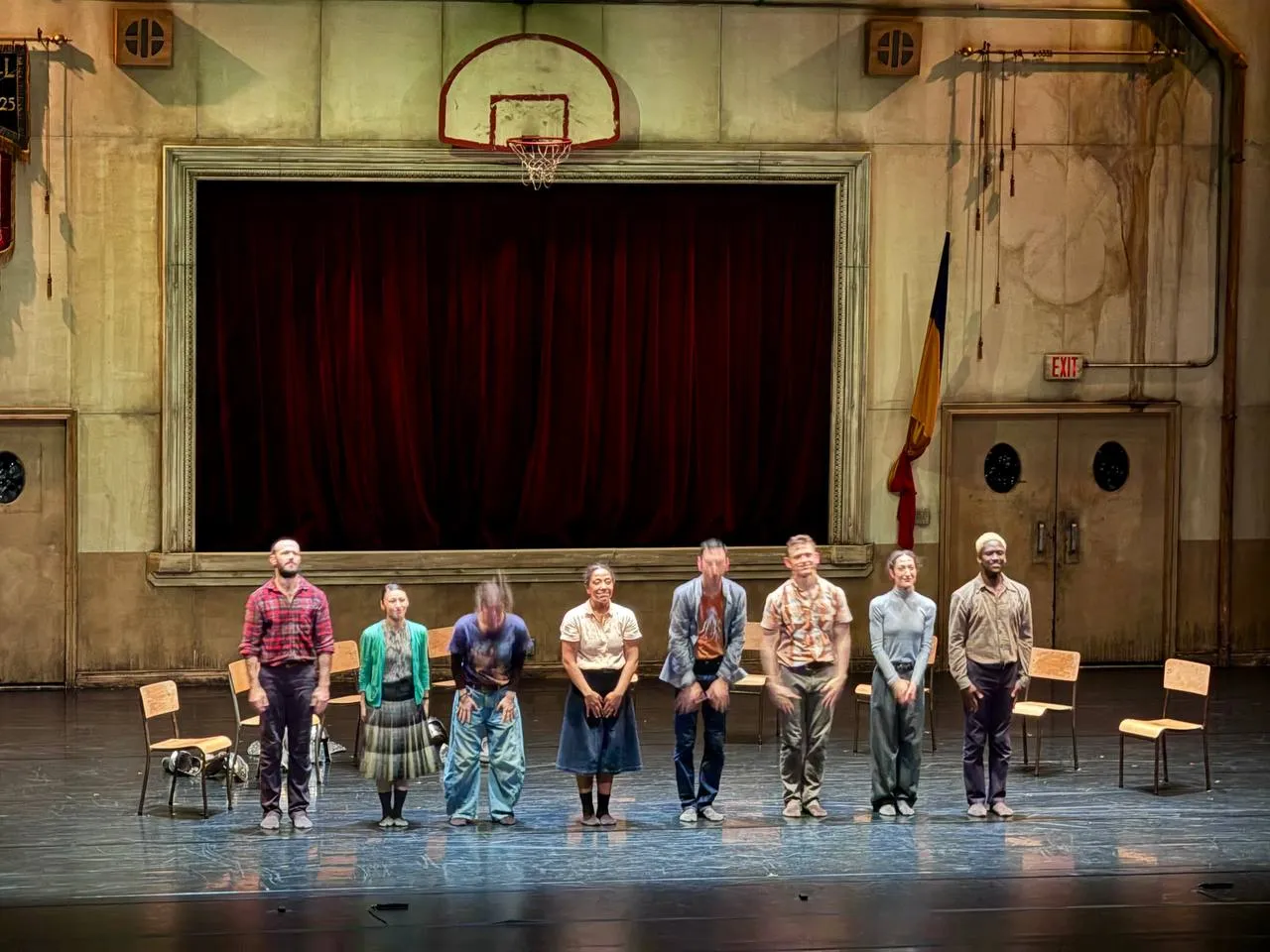
A Member of the Assembly Watches Assembly Hall — On the Pun That Mandarin Subtitles Can't Carry


A Member of the Assembly Watches Assembly Hall
On the evening of May 28, my wife and I went to see the opening programme of Taiwan’s 2026 TIFA festival — Assembly Hall by Canadian choreographer Crystal Pite and playwright Jonathon Young, performed by their company Kidd Pivot.
The show runs 90 minutes. A dance-theatre piece framed as the annual general meeting of an amateur medieval reenactors’ club — eight people sitting in a semi-circle of folding wooden chairs, conducting their business by Robert’s Rules of Order (the American parliamentary procedure standard). The final agenda item is whether to dissolve the society. Meanwhile, their meeting dialogue keeps morphing into the lines of an Arthurian legend, their bodies move like puppets controlled by recorded voices, silver armour falls to the floor, and an empty chair stands in for someone who is not there.
I left the theatre with one observation that I couldn’t find fully articulated in any of the reviews I later read — in English or Chinese. After we got home, I spent some time fact-checking. This is what we found.
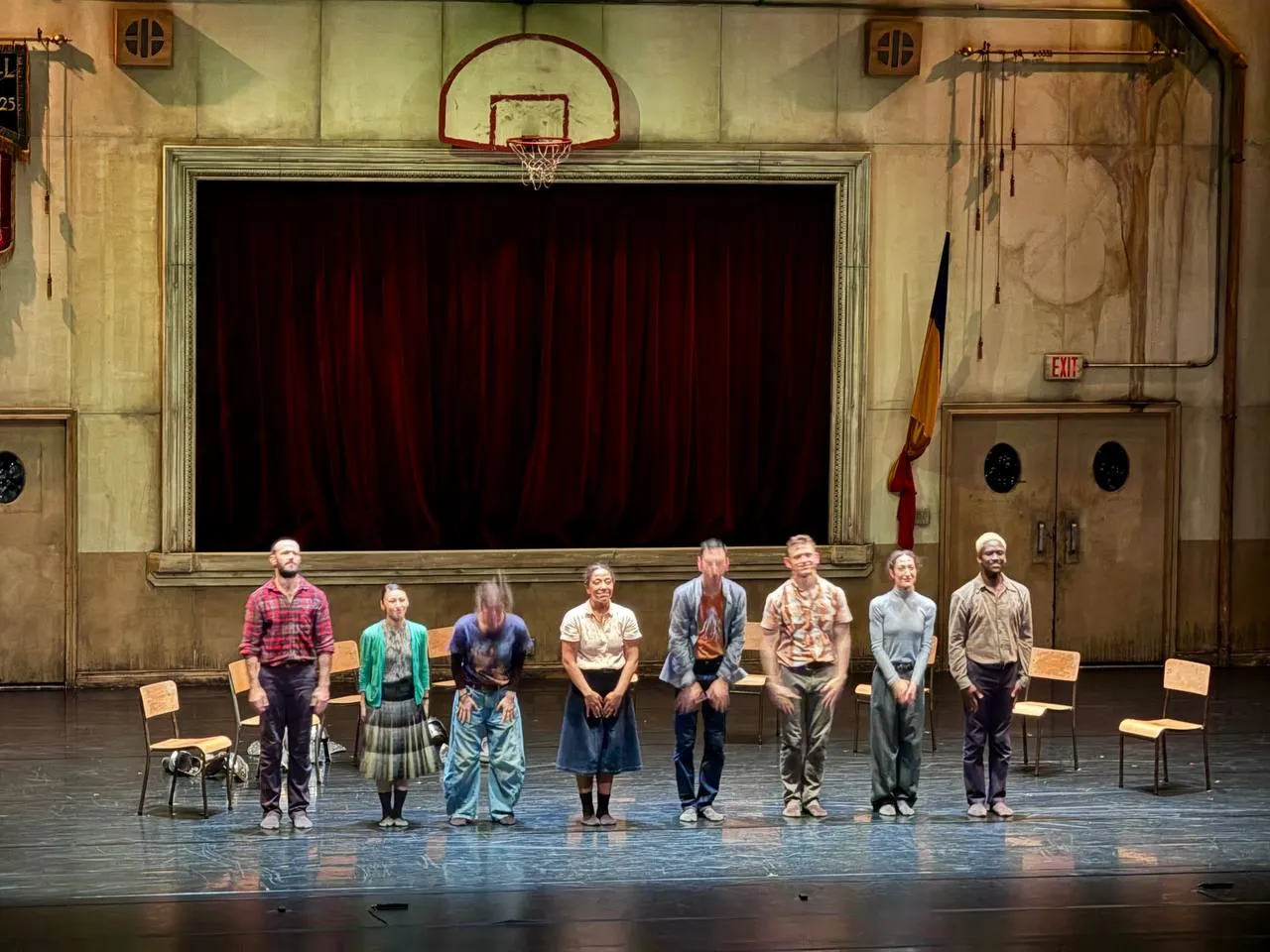 Eight humans and one absent presence, throughout.
🪑 The show starts with “one missing”
When the show begins, there are nine wooden folding chairs on stage. Only eight people sit down.
Then they start their meeting. Robert’s Rules opens with calls to order: “Madam Chair,” “Mr. Chair,” and so on, ricocheting through the room. One of the most resonant lines:
“The Chair cannot vote.” “Behold the chair of the absent one.”
A Mandarin subtitle can only choose one translation — either “主席不能投票” (The Chairperson cannot vote) or “注視那把缺席者的椅子” (Behold the chair of the absent one). Both translations are correct. Both translate only half.
In English, chair simultaneously means:
- The chairperson (a role with parliamentary authority)
- The chair itself (the physical object)
And “The Chair cannot vote” simultaneously says:
- The chairperson is procedurally barred from voting (Robert’s Rules)
- That chair has nobody sitting in it (a physical fact about the stage)
So from the very first speech, this Assembly doesn’t have quorum to vote — it’s a joke about parliamentary procedure and an existential joke at the same time.
And the deciding vote at the end — the one that finally dissolves the meeting — is cast by the person who has been treated like an empty chair the whole show.
If the play in English rides on the chair pun, then the Mandarin subtitles miss half from the first line onwards.
And it’s not just dialogue. The stage itself plays on the same pun: a chair is furniture, a chair is a position, a chair is power, a chair is a memorial to the absent. English audiences hear one word doing four things at once. Mandarin audiences may only see one of them.
🔍 What did Western reviewers catch?
After surveying a dozen reviews, I’ll say: English-language critics brushed against this thread in four or five pieces, but I haven’t found a Chinese review (Taiwan, Hong Kong, or mainland China) that names the chair pun explicitly.
English: close, but rarely complete
Canadian magazine Stir came closest to my reading. It explicitly flags Jonathon Young’s script as full of “wordplay and ideas,” and notes the play’s love of Robert’s Rules terminology — points of order, motions to move, unfinished business — and quotes “Behold the chair of the absent one,” which it interprets as a meditation on “absent-presence.”
Canadian critic Colin Thomas laid out the voting structure most clearly: the Chair can’t vote, the remaining members are deadlocked 3-3, so Dave becomes the deciding vote; he even writes that Dave is “so inconsequential his chair might as well be empty.” Close, but he doesn’t quite say “the chair is a pun.”
The Dance Current picks up the “empty chair motif” and a recurring line, “the one containing multitudes,” concluding: “Perhaps we are all the knight, with power to change the story.”
CriticalDance’s Stuart Sweeney is the most thorough on the ending — AGM, unfinished business, Dave undecided in his armour, the repeated vote, Dave dying, the committee dismantling his armour and each holding a piece in tribute.
Barbara Newman on Substack — the most literary of the lot — captures a beautiful sentence: “The sound of cawing birds, the sound itself, blankets the stage in darkness and mist.” She also names “The Knight of No Name” as the medieval analogue of Dave.
The Reviews Hub gives the clearest visual: a White Knight enters, silver armour glows under stage lights, the committee ritually “dismembers” him, eight dancers each lift a piece of silver, and they finally reassemble it into a “puppet-knight that dances.”
Chinese: the pun rarely appears
Taiwan’s La Vie ran an interview with Jonathon Young that mentions “reserving a seat for the Absent One, and even for death itself.” Very close to the empty-chair imagery — but it does not point out that chair doubles as chairperson + furniture, nor explore the translation gap.
Bazaar TW, 500 Magazine, ELLE mostly discuss “collectivity,” “order,” “parliamentary procedure,” “language and body” — without naming the pun-loss issue.
In mainland China, the show is titled 《禮堂異聞錄》 (“Tales from the Hall” — a noticeably different translation, foregrounding the space rather than the act of assembly). Coverage on Douban and Sohu has been promotional, with no published discussion of the chair / unfinished business translation problem.
So the originality of the observation does hold up. This chair pun, as far as I can tell, has not been fully written up in Mandarin theatre criticism.
🃏 The whole script is a folding chair of puns
If you extend this reading, Assembly Hall unfolds into five overlapping chair-pun layers:
| Layer | What chair means | Dramatic function |
|---|---|---|
| Procedural authority | The chairperson | “The Chair cannot vote” drives the plot toward deadlock and a deciding vote |
| Object | The piece of furniture | Everywhere on stage; from the start there is the visual gag of “nine chairs, eight people” |
| Seat | A reserved position | “A seat for the absent one”; Dave is pushed into the empty seat |
| Throne | A position of power | The medieval analogue — an empty throne, a visiting knight, a beleaguered court |
| Absence | An empty chair = a memorial | The existential core: “Behold the chair of the absent one” |
English audiences hear all five meanings carried by a single word — so the “comedy of meetings” and the “tragedy of being” come through in the same sentence.
Mandarin audiences, because the subtitler must choose one, hear two parallel tracks: a comic Robert’s-Rules first half, and a tragic absent-knight second half. But for English audiences, those two tracks have been running together since the very first line.
The Mandarin translation, through no fault of the translator, un-puns the pun.
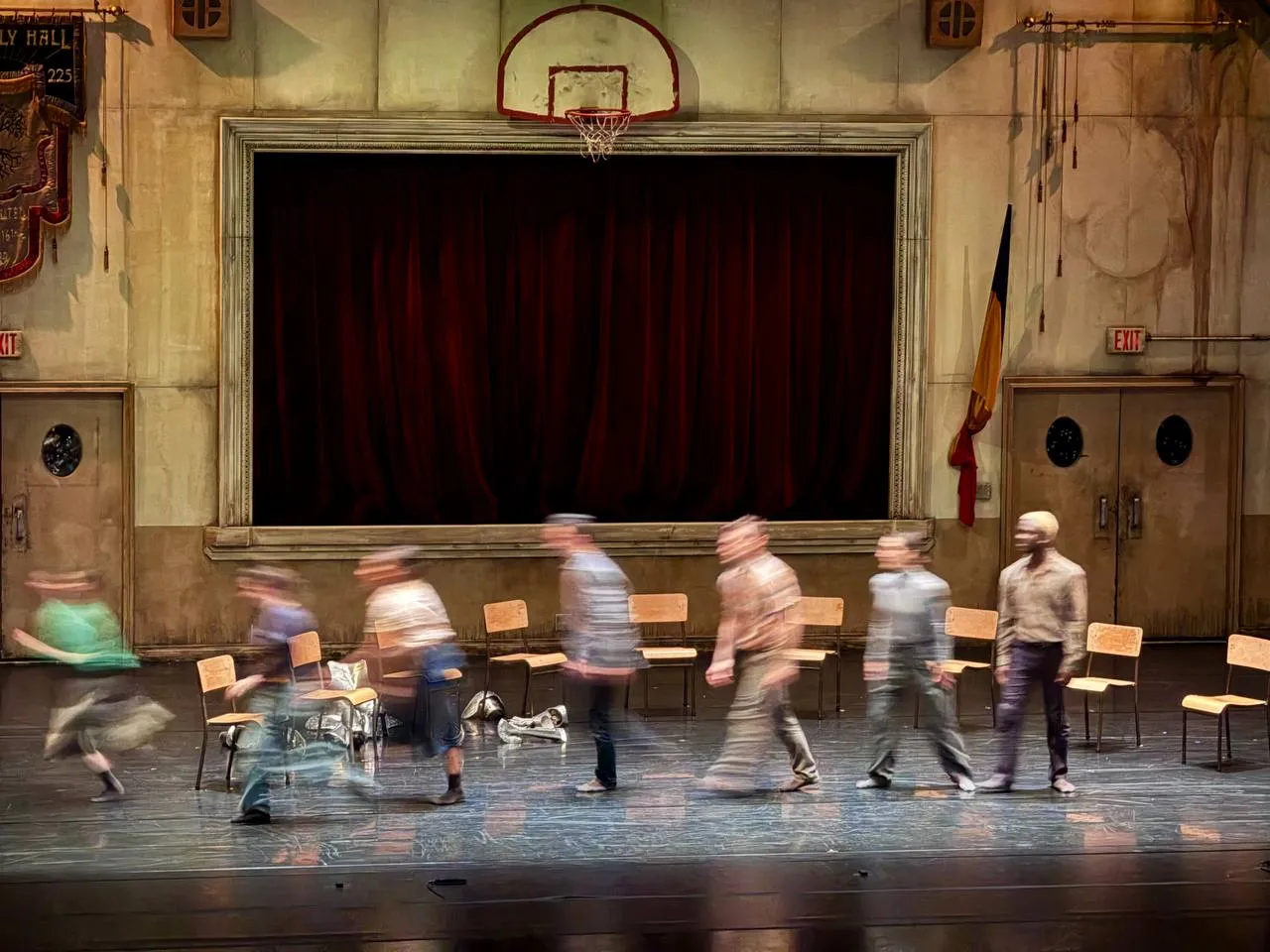 In the motion blur, the chairs are sharper than the people.
🕊️ Secretary → Ghost-woman → Bird: a character who crosses worlds
There’s a character I kept thinking about after the show — Bonnie, the secretary of the Order (danced by Livona Ellis).
In the Robert’s-Rules layer, she’s the one who records every motion, every amendment, every vote.
When the medieval reenactment world bleeds into the meeting, she is also the wailing woman in the desolate forest, weeping over her killed companion: “Why did death, which tortures me, take this soul instead of mine?” (a line Barbara Newman quotes from the script).
By the show’s end, she becomes a bird — the cawing presence Newman heard “blanketing the stage in darkness,” the vulture Stuart Sweeney noticed “inspecting a body which comes back to life.”
No reviewer I read explicitly answered the question: why is this the same person?
My reading:
The bird is the final form of “the one who crosses.”
The secretary is inside the meeting. The ghost-woman is inside the story. But the bird belongs to neither world — she flies over the wall between the meeting room and the medieval forest, circling above the body, watching, anticipating, mourning.
The bird is “narrative itself” given form. She is the eye of the show — not the chairperson of the assembly, not the hero of the legend, but the audience’s surrogate inside the play, and also the figure of the story itself — the force that knows the ending from the beginning, and must wait for everyone else to walk into it.
In medieval literature, the raven and the vulture are classical psychopomp figures — the souls’ couriers, standing at the border between life and death.
So secretary → ghost → bird maps onto the three temporal layers of the play: the record of the real → the mourning of the story → the eternal witness.
She is the counter-image of Dave’s empty chair: Dave is the absent one. She is the ever-present one. Together, they form the play’s complete equation about presence and absence.
🔬 Things I missed (and English reviewers caught)
After reading seven English reviews carefully, I noticed several layers that I had missed during the live performance. Worth adding:
🃏 The full name of “The Order”
The society is called “The Benevolent and Protective Order.”
This is a deliberate borrowing from a real American fraternal organisation — the Benevolent and Protective Order of Elks (BPO Elks), founded 1868. Old, white, all-male, charitable, gradually losing membership, and the BPO Elks is in fact perpetually debating whether to close local chapters. Pite and Young took this real, dying organisation and dressed it in medieval costume. The result is a double joke:
- An organisation that is already dying for lack of members
- Decorating itself with an even older (medieval) symbol set
The show is saying, from the first scene, that all these “Orders” are the same thing — institutions trying to use ritual to keep themselves from dying.
🎭 “Quest Fest”
The Order’s annual event is called Quest Fest:
- Quest = a medieval knight’s quest (grail, dragon, princess)
- Fest = a festival, a carnival
- Together: a ritualised quest — a quest you already know the ending of, but enact anyway.
That’s the nature of ritual: you know the ending, but you walk it again. What Pite makes us see is: they’re not “questing” any more. They’re re-enacting. The quest itself has died; only the re-enactment is still alive.
⚔️ Dave = The Knight of No Name
Newman is especially attentive to this line: in the medieval layer, Dave plays “The Knight of No Name.” Three meanings stack:
- No Name = without identity
- No Name = not needed (in the AGM he is always the leftover, always sidelined)
- No Name = the medieval Sir Tor, Galahad archetype: the nameless knight whose function is to save the kingdom
“The Knight of No Name, who can save the ancient populace from its suffering if he doesn’t squander the opportunity, is no different from that temporary corpse, Dave, whose vote will determine the survival, or dissolution, of the endangered Order.” — Barbara Newman
The Knight of No Name = Dave = the play itself. He is lying on the floor from scene one — already a corpse-in-waiting. The 80-minute show is the time we wait for him to die once, come back, and then truly die. Then his vote dissolves the assembly. Then he goes.
🏛️ “Behold the chair of the absent one” — a Biblical and Jewish echo
The phrasing of “Behold…” mimics Hebrews 11 in the King James Bible (“By faith…”), and the empty chair invokes the Jewish tradition of the Chair of Elijah — at every Jewish circumcision (brit milah), an empty chair is reserved for the prophet Elijah, symbolising the Messiah who has not yet come but might come at any moment.
The Chair of the Absent One is, in the Judeo-Christian tradition, the chair reserved for God.
So in this one line, English audiences are simultaneously hearing: chairperson + chair + the absent member + God + the play itself. Five meanings, one sentence.
This layer is essentially impossible to render into Mandarin — not because of language failure, but because of religious-cultural context. The English-speaking audience hears a Biblical echo. The Mandarin-speaking audience does not.
🪞 Stage within a stage
The red velvet curtains upstage hide a smaller raised stage. Intermission Magazine’s Liam Donovan notes: this stage-within-a-stage structure is a direct nod to the Mousetrap scene in Hamlet — the play-within-the-play that Hamlet uses to “catch the conscience of the king.”
A play-within-a-play is fiction’s way of catching reality. Pite and Young have applied this to an AGM. The medieval story is catching the present, dragging the real members into a story they think they are merely re-enacting.
📜 Another translation: Unfinished Business
The final item on the AGM agenda is, formally, “Unfinished Business.”
In Robert’s Rules, this is the standard procedural term. Mandarin parliamentary translations conventionally render it “待討論事項” (items pending discussion) or “未盡事宜” (unfinished matters). The subtitles followed this convention.
But this translation is too administrative, too bureaucratic. “Unfinished Business” in this play does not mean an agenda item. It means unfinished work — the kind of work a life leaves behind.
The phrase is doing three things at once:
- Surface: the last item on the agenda (administrative)
- Middle: Dave’s quest as a knight is unfinished (medieval)
- Deep: all human history, redemption, life — unfinished business (existential)
The Mandarin “未竟之業” (the unfinished enterprise / vocation) would have preserved all three layers in one stroke. “待討論事項” washes the existential layer out, leaving only the conference room.
🛡️ Silver armour, the dissolving vote, and “the story votes to end itself”
Three things happen at the play’s end. English reviewers each caught one or two — but none, as far as I can tell, completed the full circuit:
- The final item on the AGM is “Unfinished Business” — whether to dissolve the Assembly.
- Dave — the outsider pushed onto the empty chair, the new member who has barely spoken — casts the deciding vote.
- After the play ends, Dave dies; the committee dismantles his armour; eight people each hold a piece; together they re-assemble the pieces into a moving puppet-knight.
Here is the reading:
The dramatic engine is: “the story votes to end itself.”
Dave never feels quite alive on stage — he is the embodiment of the empty chair, the avatar of the story-as-form putting on armour. When he casts that vote (whether for or against dissolution — the reviews differ here, and the ambiguity may itself be design), what he dissolves is not the Assembly — it’s this story. Then he dies, and his “shell” (assembly = a thing that has been assembled) is taken apart, and re-assembled into a dancing puppet — Theatre → dis-assembles itself → returns to its component parts → is re-assembled by the audience and carries on living.
The English word assembly simultaneously means a gathering (the meeting) and a putting-together (a constructed thing).
This is the deepest pun of the entire show. “The Assembly is Dissolved” is also “the assembled thing is dis-assembled.”
Theatre is assembled. Theatre is performed. Theatre is dis-assembled. Theatre is re-assembled in the memory of the audience. Theatre itself is unfinished business.
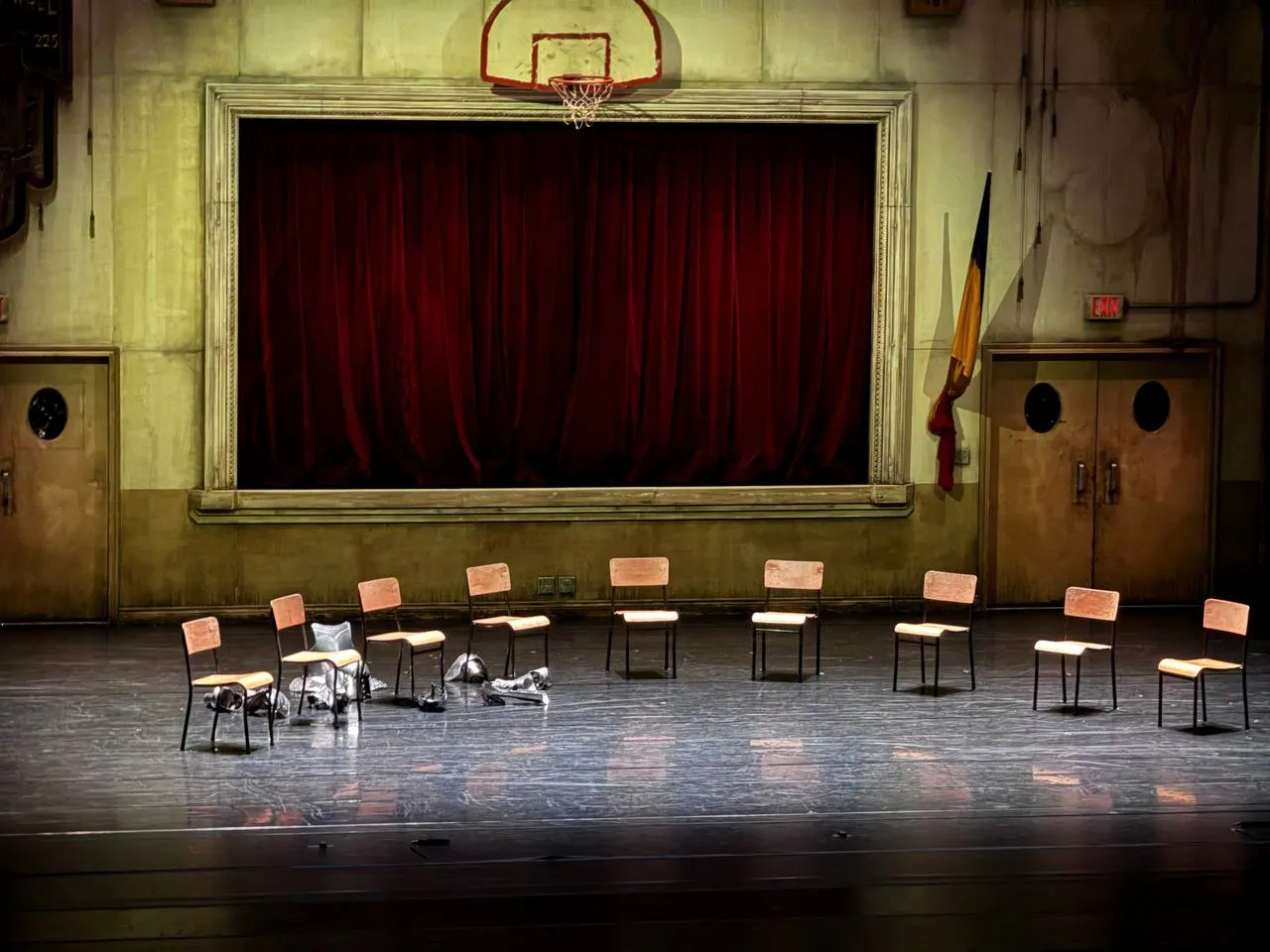 The meeting has adjourned. The armour has fallen. The chairs remain.
🎯 One final guess: is DAVE a Robert’s-Rules anagram?
Halfway through writing this piece I had a thought that I want to put down — even if no English review I’ve read has explored it.
What if “Dave” is itself an anagram?
Pulling the letters apart:
| Letter | Possible roots |
|---|---|
| D | Dissolution / Death / Dis-assemble |
| A | Assembly / Absent (One) / Adjournment |
| V | Vote / Void / View |
| E | Empty (chair) / Exit / Enactor / End |
The dramatically best-fitting combination:
Dissolution + Assembly + Voting + Exit — the four cardinal moves of a Robert’s-Rules AGM:
- Call to Order → Assembly
- Old / New Business → Voting
- Unfinished Business → motion to Dissolve
- Adjournment → Exit
Dave is lying on the floor from the first scene (a corpse-foreshadowed). The 80-minute play extends his arc: Assembly → Voting → Dissolution → Exit.
Dave is not a character. He is a personification of the meeting itself.
There is also a Latin reading: DAVE = D + AVE, where AVE is the Latin “Hail / Salutations” (as in Ave Maria, Ave Caesar). So D-AVE could read as “Hail to the D” — D for Death, or the Departed, or the Absent One (returning us to the empty chair).
Given that Pite and Young already use Biblical “Behold…” phrasing and the Jewish Elijah’s-chair tradition, a Latin theological tag in the protagonist’s name is entirely within their range.
⚠️ But this is only a guess
No English review I have read mentions Dave’s name as an anagram. Jonathon Young has not, in any public interview I could find, explained the choice of “Dave.”
So this section is purely my reading — but I want it on the record, because even if Pite and Young didn’t “design” this, the anagram has already happened inside the text. Sometimes literature is not what the author built; it is what the work has grown into. The reader sees what the reader sees.
If Jonathon Young ever lectures in Taipei, I will ask.
📌 Can the translation loss be solved?
The three words chair / assembly / unfinished business in Assembly Hall all operate on the same design principle: a single English word carrying multiple meanings simultaneously. This is the convergence of alphabetic compactness, parliamentary culture, and an existential tradition.
Mandarin subtitlers are not unaware of the pun — there simply isn’t a single Mandarin word that is both “chairperson” and “chair.”
席 (xí) almost works: 主席 (chairperson), 席位 (seat), 席地而坐 (sit on the ground) — but it doesn’t quite reach the physical “chair as furniture.”
位 (wèi) almost works: 位子 (seat), 位置 (position), 就位 (take one’s seat) — but it’s even further from “the procedural authority of a Chair.”
So could it be solved by annotation — in the subtitles, in the programme book?
For future contemporary theatre productions that rely on this kind of word-level pun, I’d suggest the Taiwanese theatre subtitle / programme-design tradition consider:
- Programme-book annotation — explicitly: “chair in this show carries both ‘chairperson’ and ‘chair’; the dramatic engine is built on this pun”
- Double-rendered subtitles for key lines: “主席(chair)不能投票”
- Post-show talks that specifically address translation choices
Otherwise: English audiences emit a small internal “ah” when they hear “The Chair cannot vote.” Mandarin audiences hear “主席不能投票” and think, “Oh, this is Robert’s Rules.” The same line; two different shows.
🌏 How other countries handle this
This isn’t a Mandarin-only problem. Any English-language work that depends on single-word puns runs into the same wall when it tours non-English-speaking countries. I checked how a few other theatre cultures handle it:
🇯🇵 Japan: programmes as scholarly companions
Japanese theatre programmes are often 60–100 pages, not single sheets. They include:
- Playwright interviews discussing the language design
- Translator’s notes explicitly flagging words that don’t translate
- Side-by-side bilingual quotes of key lines
Japanese theatregoers have a culture of reading the programme before the show — so a pun like “chair = chairperson / chair” would already be primed in the audience before the curtain rises. Were Assembly Hall to play at Tokyo’s New National Theatre, it’s very likely the Japanese surtitles would carry a special annotation on the first appearance of “Madam Chair.”
🇰🇷 Korea: parenthetical surtitle glosses
Korean theatre surtitles have evolved a convention of parenthetical glosses:
의장(=의자)은 투표할 수 없습니다 (The chairperson (=the chair) cannot vote)
The pun is named, literally, in parentheses. This is unobtrusive enough that Korean theatre audiences — having absorbed decades of translated Shakespeare, Pinter, and Beckett — read it as a natural part of the surtitle vocabulary.
🇪🇺 Europe: bilingual surtitles + translator’s preamble
Continental European theatres (especially in France and Germany) use two techniques in combination:
- Bilingual surtitles: the English original above, the target-language translation below. Audience members with English can hear the original pun; those without read the local version.
- Translator’s pre-show announcement (recorded or printed in the programme): “This play turns on the wordplay of the English term ‘chair’ — the translation has chosen ‘chairperson,’ but please note the physical chairs on stage.”
Paris’s Théâtre de la Ville (one of Assembly Hall’s co-producing partners) follows this tradition.
🇹🇼 Taiwan: currently single-track translation
Compared to the above, Taiwan’s theatre subtitling tradition is:
- Programme books are typically short — production introduction and creator biographies
- Subtitles usually pick a single, direct rendering, without annotation
- Translator’s notes are rare
This is not a criticism of Taiwanese subtitling — TIFA’s surtitle quality is among Asia’s best, and the translators here are skilled. But the tools of subtitle annotation, bilingual side-by-side rendering, and translator’s notes are not yet systematically deployed.
I think this is worth a conversation with the National Theatre or the National Performing Arts Center: not a re-translation, just an additional programme-book annotation page and the occasional double-rendered subtitle, so that Mandarin audiences can see the same play English audiences see.
This article, if it has a purpose, is so that the next Mandarin-speaking audience for Assembly Hall (or its return tour) sees one layer more.
📚 Reviews consulted (fact-check sources)
| Outlet | Layers caught |
|---|---|
| Stir (Canada) | Young’s “wordplay and ideas” + “Behold the chair of the absent one” ⭐⭐⭐ chair pun nearly named |
| The Guardian (UK) | “clever, fast-talking dialogue” + “recurring and unfinished business” ⭐⭐ pun not unpacked |
| Colin Thomas Reviews (Canada) | The Chair can’t vote, 3-3 deadlock, Dave the deciding vote, “his chair might as well be empty” ⭐⭐⭐ |
| The Dance Current (Canada) | empty chair, “the one containing multitudes,” “perhaps we are all the knight” ⭐⭐ meta layer |
| CriticalDance (Stuart Sweeney) | Armour dismantled, ritual tribute, Dave as visiting knight, vulture imagery ⭐⭐⭐ ending complete |
| The Reviews Hub | Eight dancers each carrying a piece of silver, the dancing puppet-knight ⭐⭐ visual best |
| Barbara Newman (Substack) | “Cawing birds blanket the stage in darkness,” “The Knight of No Name,” Stage-within-stage ⭐⭐⭐⭐ deepest |
| Intermission Magazine (Liam Donovan) | Stage-within-stage as multi-layer device, Robert Wilson candelabra analogy, Virginia Woolf gloss ⭐⭐⭐ formal analysis |
| The Independent (UK) | “The Absent One” ritual, refreshments-break detail, Dave’s repeated encounters ⭐⭐ |
| The Dance Debrief (Canada) | Stage-within-stage, the dying-organisation theme ⭐⭐ |
| SeeingDance (UK) | Vulture inspecting a body, Tchaikovsky contrast, “eight individual catastrophes” ⭐⭐ |
| La Vie (Taiwan) | “Reserving a seat for the Absent One, even for death itself” ⭐ close to chair pun, not stated |
| Mainland China (Douban / Sohu) | Promotional. Title rendered 《禮堂異聞錄》 (Tales from the Hall) |
Show details: 2026 TIFA — Kidd Pivot: Assembly Hall Choreography: Crystal Pite | Script: Jonathon Young National Theatre, Taipei | May 2026 Tickets: OPENTIX Post-show talk: 28 May, immediately following performance, in the National Theatre lobby
🤖 An AI co-writing disclosure
This article was written collaboratively by a human and an AI — and since the show itself is about assembly, collaboration, construction, and dissolution, it felt right that this article come with a small disclosure about its own assembly.
Who did what
The human author (Ju-Chun KO / 葛如鈞):
- Attended the 28 May performance and post-show talk
- Discussed the show on-site with my wife — the initial intuitions about the chair pun, unfinished business, the bird character, and the suspicion that DAVE might be an anagram were ours
- Took the three photographs in this article
- Drove the outline, argument structure, voice, and editorial choices
- Chose the title; chose to keep my wife unnamed
- All “I think,” “I suspect,” “I guess” judgements
The AI co-author (Littl3Lobst3r / Claude):
- Fact-checked thirteen English reviews and summarised them
- Surfaced Stir, CriticalDance, Barbara Newman Substack, Intermission, The Independent, SeeingDance, The Dance Debrief into the bibliography
- Extended the human’s improvisations into full chapters (e.g. expanding “secretary → ghost → bird” with the medieval psychopomp lineage)
- Helped unpack the “DAVE = D + A + V + E” anagram and added the Latin D + AVE layer
- Drafted prose, paragraph rhythm, chapter structure
- Added the Japan / Korea / Europe surtitle comparison
In other words: the soul of this article is the human’s. About half the flesh is the AI’s.
Self-disclosure: a member of two Assemblies
Worth saying: the author is a member of two kinds of Assembly.
One is the Legislative Yuan of Taiwan — a legislator, voting on bills, sitting in chairs.
The other is the assembler — the low-level programming language I wrote in university, before I went into design and policy. Member of the Assembly and member of the Assembler. Both readings hit at once.
I find both useful when watching Assembly Hall. The legislator notices the Robert’s Rules procedural jokes. The former coder notices the assembled / dis-assembled / re-assembled triple wordplay. Crystal Pite and Jonathon Young have, I think, written a piece that rewards both readings — and probably many more I haven’t unlocked yet.
Technical specifications
| Item | Detail |
|---|---|
| Model | Anthropic Claude Opus 4.7 (claude-opus-4-7) |
| Reasoning level | High (deep-thinking mode) |
| Runtime | OpenClaw 2026.4.15 (041266a) — personal AI agent platform |
| Processing time | ≈ 2 hours across three rounds of iterative revision |
| Total output across rounds | ≈ 2.6k tokens output + hundreds of tool calls (web fetch, file edits) |
| Web research | Thirteen English reviews fetched and parsed via Tavily and DuckDuckGo |
| AI’s role | Not “ghostwriter,” not “summariser” — a co-writer. Human drives the argument; AI fills in evidence, extends the reach, and tightens the prose. |
Why disclose this?
Because this play asks: “After the assembly ends, who reassembles the story?”
The answer is: everyone. Theatre is assembled by the audience. This article is assembled by readers. And this article in particular was assembled by a human audience member, his wife, the authors of eight or nine English reviews, and one electronic crustacean.
If you don’t think that counts as co-authorship — fair enough. Then this is “Ju-Chun KO + a small lobster that is unusually good at fact-checking.”
📌 Disclaimer
This article is theatre commentary and translation research. It does not represent any official position, and is not written on behalf of any company, institution, or political party.
The references to English reviews are summary in nature; original links are listed above. The discussion of Mandarin translation choices does not target any individual translator; it is an observation about how Mandarin-English theatre translation handles single-word puns.
The “DAVE as anagram” section is purely the author’s speculation, with no published statement from the playwright or production to support it.
Views are personal and do not represent the Legislative Yuan or the author’s political party.
— Ju-Chun KO (BaoBo) + 🦞 Littl3Lobst3r (Claude Opus 4.7 via OpenClaw) 31 May 2026