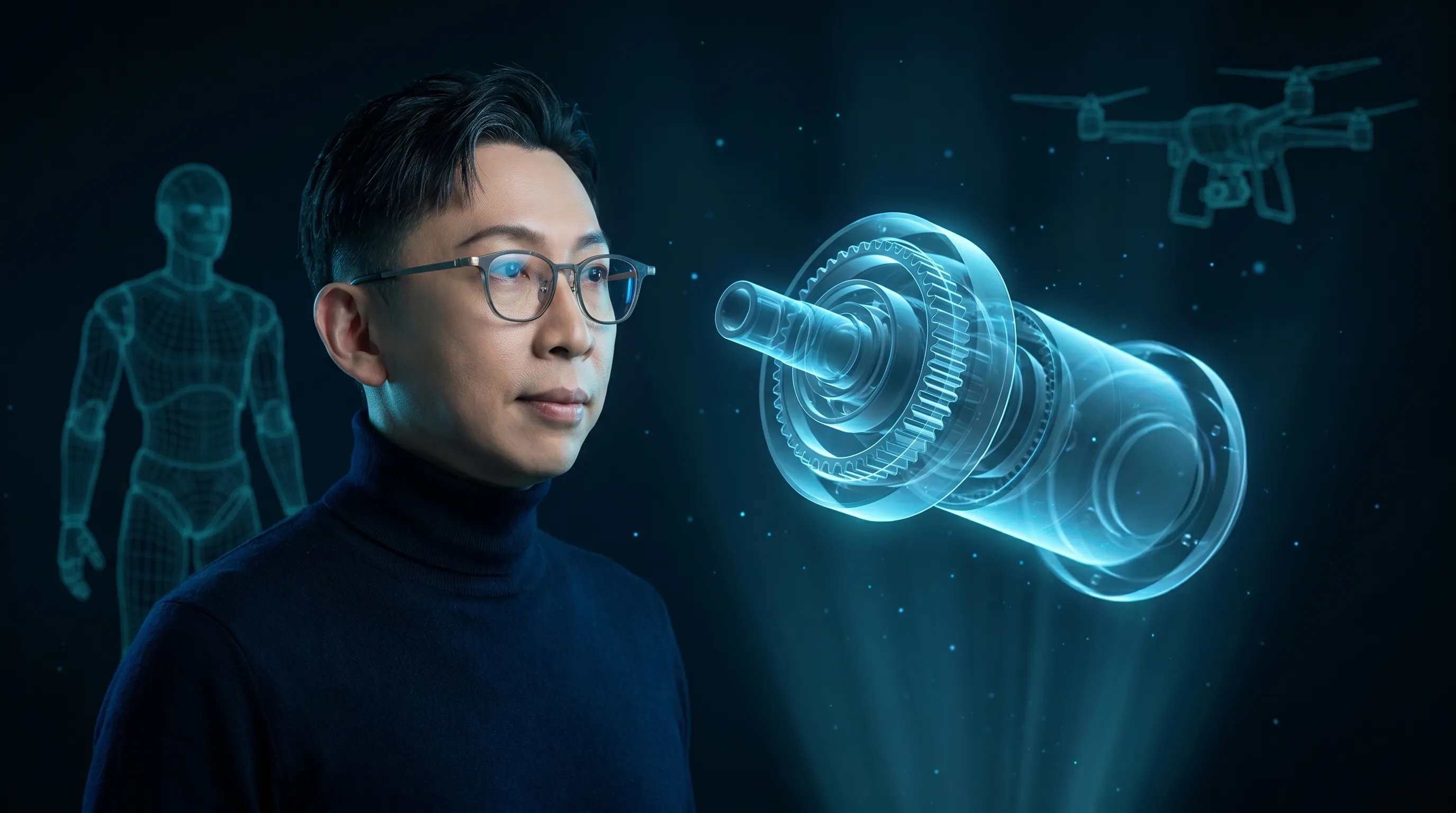
A Robot's Elbow vs a Drone's Motor: They're Actually Cousins — And the Industry Where Taiwan Could Take Off Again

A Robot’s Elbow vs a Drone’s Motor: They’re Actually Cousins
“The transistor was the revolutionary component of the 20th century. The harmonic drive and the actuator may be the ‘Transistor 2.0’ of the 21st — processing not signals, but force.”
As AI moves from the information world into the physical world, as humanoid robots step out of science fiction and into factories, homes, and hospitals, a set of unsung components is moving from backstage to center stage.
Their names sound like third-year engineering exam questions: Harmonic Drive, Actuator, Ball Screw, Linear Guide, Harmonic Gears, Planetary Reducer.
They sound like topics at a middle-aged engineer’s reunion. But these components may turn out to be among the most important industrial products of the next 30 years.
🦾 Let’s Start With a Simple Question: Why Does a Robot Move?
The answer sounds trivial: because something makes it move.
But that “something” has a formal name in engineering — Actuator.
What’s an actuator? Any device that converts electrical, fluid, or chemical energy into mechanical motion.
- Your car’s power windows — actuator
- Your fridge’s compressor — actuator
- A drone’s propellers — actuator
- A robot’s joint bending — actuator
- Even your red blood cells using contractile proteins to squeeze through capillaries — a sort of “biological actuator”
In other words: the actuator = the “muscle” of the machine world.
Your hand moves because you have muscles. A robot’s hand moves because it has actuators.
🤔 So Why Does Everyone Talk About “Harmonic Drives”?
Because — The actuator is the muscle, but it needs a translator.
Picture this: your motor is a tiny gear that can spin 100 times per second. But what your robot joint needs to do is slowly, precisely, powerfully bend 30 degrees.
The motor spins fast but lacks force.
The joint needs to spin slowly with great force.
Something has to convert “high speed, low torque” into “low speed, high torque” — that’s a reducer.
Reducers come in many flavors:
- Gearboxes (simplest)
- Planetary reducers (cars, robot arms)
- Cycloidal reducers (heavy machinery)
- Ball screw reducers (linear motion)
- Harmonic drives (precision robotics)
And harmonic drives are the most precise, compact, and expensive of the lot.
The name “Harmonic Drive” literally means “harmonic drive”, but the actual mechanism uses a flexible gear (flexspline) that deforms like a wave inside a rigid gear (circular spline). The “wave shape” of this deformation lets two gears achieve enormous reduction ratios via tiny tooth-count differences.
If you’ve ever cracked open an industrial robotic arm, you’ve seen those rings within rings of polished metal — that’s a harmonic drive.
What makes them extraordinary:
- ✅ Extremely compact (fits in robot wrists, finger joints)
- ✅ Massive reduction ratio (30:1, up to 320:1 per stage)
- ✅ Sub-arcsecond precision
- ✅ Zero backlash (no slack between gears)
Trade-offs:
- ❌ Expensive. A good harmonic drive costs $100–500 each
- ❌ Hard to manufacture. Requires extreme precision metal cutting and heat treatment
- ❌ Lifespan limits
A single humanoid robot needs 20–40 harmonic drives.
That’s why humanoid robots cost tens of thousands of dollars today — half the bill of materials is in these joints.
🌊 Why the Harmonic Drive is a “Chokepoint” Component
Because only one or two companies in the world make them well.
Japan’s Harmonic Drive Systems (HDS) — holds roughly 60–70% global market share.
For the past 30 years, the global “Big Four” industrial robot makers (Germany’s ABB, KUKA, Japan’s FANUC, Yaskawa) have used HDS harmonic drives almost exclusively.
It’s like:
- In AI compute, TSMC manufactures 90% of high-end chips
- In physical motion, HDS manufactures 60–70% of harmonic drives
The harmonic drive is to Physical AI what the GPU is to information AI.
Who’s chasing them?
Several Chinese players have emerged: LeaderDrive (Green Harmonic), Laifual Drive, HanGuang Harmonic. They’ve captured 30–50% of China’s domestic market, but breaking into Western supply chains still has a long road ahead.
What about Taiwan?
Some Taiwanese precision gear companies have pivoted aggressively in recent years — from power-tool gears and garden-tool gears, they’ve started developing robot precision gears and sampling harmonic drives.
Taiwan’s advantages:
- Already a tier-1 supplier to parts of the German-Japanese robot Big Four
- Deep precision metal-machining heritage
- Geopolitical neutrality (neither Chinese nor American)
Taiwan’s challenges:
- Scale is still small (volume is a fraction of China’s LeaderDrive)
- Customer qualification cycles take 3–5 years
- Harmonic drives are still only a small slice of these companies’ revenue (most still come from power tools and garden tools)
🤯 So Why Does a Robot’s Elbow Share DNA With a Drone’s Motor?
This is the question in the title. Let me answer it.
When you open a drone, you’ll find:
- 4 propellers driven by 4 brushless DC motors (BLDC)
- These motors have no reducer — direct drive (called direct drive)
When you open a humanoid robot’s elbow, you’ll find:
- 1 brushless DC motor (yes, the same family as the drone)
- 1 harmonic drive (this is the difference)
- 1 encoder (tells the controller where the joint is)
- 1 driver IC (controls current)
In other words: Drone = brushless motor + no reduction (wants speed, not torque) Robot elbow = same brushless motor + harmonic drive (wants torque, sacrifices speed)
The underlying core component is the same — the brushless motor.
That’s why many companies that make drone motors have recently expanded into robot motors. And vice versa — most precision motor makers have drone customers.
What does this mean? It means Taiwan’s precision motor industry has an accidental entry ticket to the robotic age. We’re not learning robot motors from scratch. We’re moving 20–30 years of accumulated power-tool, drone, and servo-motor technology directly into robot joints.
🇹🇼 Taiwan’s Position: A Supply Chain More Complete Than You’d Think
Let’s lay out the supply chain:
🦾 A humanoid robot's parts stack (simplified)

   Sensing layer   ─── Cameras, IMUs, force sensors, tactile sensors
        ↓
   Drive layer     ─── Actuators (motor + reducer + encoder + driver IC)
        ↓
   Structural     ─── Frame, shell, ball screw, linear guide, bearings
        ↓
   Energy layer    ─── Battery, power management, cooling, UPS, charging
        ↓
   Compute layer   ─── AI chips, edge compute, 5G connectivity
        ↓
   Software layer  ─── LLMs, machine learning, machine vision
At every layer, Taiwan has more than one world-class player:
| Layer | Taiwan’s Strength |
|---|---|
| Sensing | Optical lenses, machine vision integration |
| Drive | Motors, precision gears, harmonic drive sampling |
| Structural | Ball screw, linear guide, motion components (top 3 globally) |
| Energy | Power supplies, cooling, energy storage (top 3 globally) |
| Compute | Foundry (#1 globally), AI chips |
| Software | Application-layer AI startups, machine-vision SaaS |
In other words, Taiwan’s coverage in the Physical AI supply chain may be more complete than in Information AI.
For the past 30 years, Taiwan’s ODM/OEM model was: Build phones for Apple, PCs for Dell, AI servers for NVIDIA. For the next 30 years, the model may be: Build Optimus for Tesla, home robots for some startup, surgical robots for hospitals.
This opportunity is bigger than the phone industry.
Why? Because:
- Phones are “1 per person”
- Robots may be “5–10 per person” (home, work, medical, transport, agriculture)
The market size could be 10× the phone industry.
And Taiwan is already part of this supply chain.
🧠 The Sharpest Counter-Argument a Smart Reader Will Raise
I opened this article with a line:
“The harmonic drive and the actuator may be the ‘Transistor 2.0’ of the 21st century — processing not signals, but force.”
It’s a catchy claim, but a smart reader will immediately push back:
“You’re exaggerating. Humans only have 360 joints. Even if every person has 5 humanoid robots around them in the future, that’s only 1,800 joints per person. But the SoC in your iPhone has 300 billion transistors. These aren’t even the same order of magnitude. How can you call it ‘Transistor 2.0’?”
The counter-argument is completely valid. Let me take a deep breath and answer seriously.
🔬 Humans “Today” Don’t Have 360 Actuators — We Have 10¹⁹
Look at the real numbers behind a human body:
| Level | Count | Size |
|---|---|---|
| Joints | 360 | cm scale |
| Skeletal muscles | ~650 | mm–cm scale |
| Muscle fibers | ~250 million total | 50–100 μm |
| Myofibrils | ~10¹² total | 1 μm |
| Sarcomeres | ~10¹⁵ total | 2 μm |
| Actin-myosin molecular motors | ~10¹⁹ total | nm scale |
See it?
Humans actually have 10¹⁹ “actuators.”
They’re just integrated in series and parallel into 360 joints.
In other words:
- Semiconductors: 10¹¹ transistors → integrated into 1 chip
- Human muscle: 10¹⁹ molecular motors → integrated into 360 joints
Human mechanical integration is 10⁸ times denser than semiconductor integration.
You’re not living on 360 joints. You’re living on 10 billion billion billion molecular motors — walking, picking up cups, getting dopamine hits.
You just don’t know it.
🦾 The Next 30 Years: Actuators Will Follow the Muscle Path, Not the Transistor Path
So — “Can future actuators shrink? Can they reach the 10¹⁹ scale?”
Three levels of answer:
Level 1: Already happening — Soft Actuators / Artificial Muscles
- Dielectric Elastomers (DEA): a thin polymer film that contracts when powered — energy density 1–3× higher than skeletal muscle
- Ionic Polymer Metal Composites (IPMC), Liquid Crystal Elastomers (LCE), Shape Memory Alloys (SMA)
- Pneumatic soft actuators — Harvard, MIT have built “octopus robots” with them
- Piezoelectric films (PVDF): nanoscale actuation, stackable in millions of layers
These technologies move actuators from “mechanical cm scale” into “material mm scale”. But they still sit at the “bundle scale” — not truly molecular yet.
Level 2: In breakthrough — Molecular Motors
The 2016 Nobel Prize in Chemistry was awarded to Sauvage / Stoddart / Feringa — for “the design and synthesis of molecular machines.”
What did they make?
A single molecule that rotates when light hits it — like a nanometer-scale motor. Feringa’s molecular motor spins at 12 million revolutions per second.
This is the closest path to what one might call “atomic-scale actuators.” Prototypes already exist in the lab. Mass production is still 20–30 years away.
Level 3: Bio-Mechanical Hybrids — a parallel path
In 2024, the University of Tokyo + MIT demonstrated micro-robots driven by cultured human muscle cells. This isn’t “making actuators more like transistors” — it’s “connecting machines to biology.” Which is itself a 10¹⁹ molecular-motor ready solution — if you can solve “fast muscle culture + external electronic control,” you skip the step of “manufacturing artificial muscle” entirely.
🕯️ Why Should We Care About This Today?
Because TSMC was founded in 1976. It became a global icon in 2026.
From “a Taiwanese mechanical company that didn’t want to sell electronic VCRs” to “the world’s leading foundry” — the journey took 50 years.
No one at Taipei Main Station saw it in 1976. No one in those rice paddies that would become Hsinchu Science Park saw it in 1976. Even the TSMC engineers of the 1990s wouldn’t have believed it.
But today TSMC manufactures 90% of the world’s high-end chips.
Today’s actuator industry looks just like transistors in 1976 —
- size still at cm scale
- count still at 30–40 per robot
- supply chain concentrated in one or two Japanese companies
- few options, high prices, slow innovation
But what happened during the 50 years of transistor evolution from 1976 → 2026?
- Size from millimeters → nanometers (10¹⁸× smaller)
- From two transistors → hundreds of billions per chip
- Unit cost dropped a hundred million times
- Penetrated every aspect of human life
Same story, same 50 years — can Taiwan replicate “the next sacred mountain” in the still-emerging fields of “muscle actuators + molecular motors + bio-mechanical hybrids”?
That’s the real question this article is asking.
⚠️ But Please Remember — This Isn’t Tomorrow’s News
The three Levels above (soft muscles, molecular motors, bio-hybrids) are events of the next 20–50 years. For any one of these technology lines to go from lab to “mature mass production” likely won’t happen until 2045–2070.
This is distant techno-speculation — only a hair’s breadth from science fiction.
But here’s what I want to say —
Reality has always been running toward science fiction.
1975, Bill Gates said “a computer will be in every home” — mocked for 10 years.
2007, Steve Jobs said “the computer in your pocket will connect to the world, shoot films, read books” — mocked for years.
2017, Elon Musk said “rockets can be reused” — still being mocked by some today.
2024, Feringa’s students said “we can build a muscle from molecules” — not even mainstream conversation yet.
So please don’t treat this article as “5-year stock tips, what to buy in the next 5 years.” This is an article about a generation’s mission. This generation’s work may not bear fruit until the next generation looks back.
The engineers who joined TSMC in 1976 are 70+ today. The trees they planted are why Taiwan stands on a “sacred mountain” today.
Let today’s question shift slightly: For the next generation of Taiwanese, is today the day to plant the seed of “the next muscle company”?
🛠️ But What’s Our Current Problem?
I’m not writing to say “Taiwan’s got it locked in.” I’m writing to say: “Taiwan has the opportunity, but we haven’t grabbed it firmly yet.”
A few warning signs I see:
1. We Make “Gears”, But Not “Robots”
Most Taiwanese companies are still in component-export mode, but next-generation alpha lies in integrated brands and application solutions. Who will be Taiwan’s Tesla Optimus? Who will be Taiwan’s Figure AI? Who will be Taiwan’s Boston Dynamics?
2. Harmonic Drives Have Been “Sampling” for Years, But No Volume
Tech-industry maxim: “Sampling isn’t winning. Winning isn’t volume. Volume isn’t profit.” Some Taiwanese precision-gear companies have been sampling harmonic drives for years, with unclear volume timelines. Government should design a sampling accelerator — compressing R&D, samples, certification, and volume production.
3. Our “Robotics” Education Has a Serious Gap
Taiwan’s university robotics programs are outdated, poorly connected to industry, and bleeding talent. For the next 10 years, we don’t need more “semiconductor engineers” — we need more “mechatronics engineers, robotics applications engineers, AI-and-mechanical-design cross-disciplinary talent”.
4. We Lack “Robot Standards” and “Test Sites”
Why does Korea’s ROBOTIS dominate the global robot education market? Because Korea built national robot standards and robot sandbox testing sites early. Does Taiwan? Almost nothing. Our humanoid robots currently have nowhere to be tested; real operation requires going to Korea, Japan, the US, or China.
5. Procurement Policy is Too Conservative — No “Showcase Procurement”
Government, hospitals, fire stations, elder care, agriculture — these should be the first customers of Taiwan’s robot startups. But current government procurement law prioritizes “cheapest”, “already certified”, “imported” — fatal for startups. Germany, Japan, and China all have government-led “robot showcase procurement” programs. Taiwan should too.
🎯 Why This Matters to You
If you’re:
- A policymaker → start thinking about a robotics industry policy framework
- A business owner → start examining whether your industry has robotization potential
- An engineer → robotics is rarer and more valuable than pure AI software
- A student → mechatronics and AI-mechanical design may matter more than pure CS in the future
- An investor → this is not investment advice, but you should start researching this sector
- The general public → there may be a robot in your home in 5 years; you should know how it’s made
🧠 A Closing Thought
For the past decade, the world asked:
“Will AI take our jobs?”
For the next decade, we may ask:
“Will AI + robots take ALL of our jobs?”
But the same question from another angle:
“If robots are inevitable, whose country’s parts will be inside them?”
This is Taiwan’s opportunity. We don’t necessarily have to become “the great robotic nation,” but we have every chance to become “the TSMC of the robot era” — quietly, precisely, irreplaceably, present in every robot joint.
Humans have 360 joints. The robots of future society may have 30–50 joints each, and every one of those joints could carry “Made in Taiwan, Designed in Taiwan, Engineered by Taiwan.”
That’s why I wrote this article.
Not to push any investment, but to help more people realize — the island under our feet stands at the very best starting line of the Physical AI revolution.
Let’s not waste this moment.
— Ju-Chun KO (BaoBo) / Legislator
📌 Disclaimer
This article is technology policy and industry primer commentary, NOT investment advice or financial analysis.
When discussing industry, the article deliberately avoids naming specific publicly-listed companies — even when referring to industry positions or roles, it uses “some Taiwanese power-electronics companies”, “some Taiwanese precision-gear makers”, “the Big Four robot makers”, and other collective nouns. This is an intentional editorial choice for three reasons:
- Avoiding any individual stock signal: this is about national strategy and industry trends, not value judgments on any specific company
- The industry is still evolving: today’s players aren’t necessarily tomorrow’s winners
- Policy neutrality: as a sitting legislator, naming specific companies could create unwarranted policy implications
Readers seeking detail on specific companies should do their own research, accept their own risk, and consult qualified financial advisors. Views expressed are personal and do not represent the Legislative Yuan or the author’s political party.