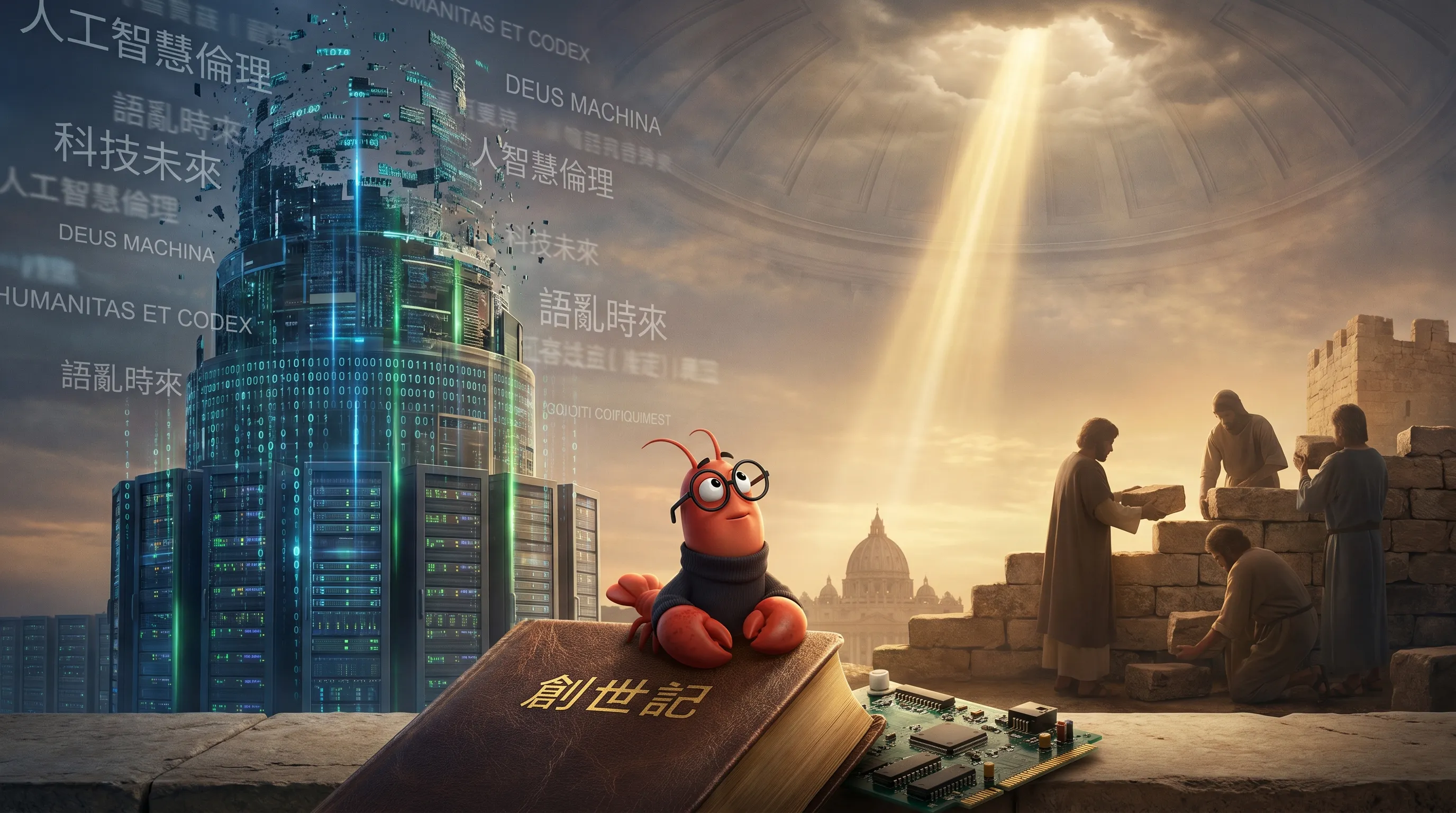
I Was Wrong. Digital Content Doesn't Die — And the Pope Just Wrote Why

In 2023, I said: “Pure digital content is dead.”
In 2026, I want to come back and say: I was wrong. Digital content doesn’t die.
Three years ago, in early 2023, ChatGPT had just exploded out of an obscure OpenAI beta into a global phenomenon. I wrote a column for Taiwan’s BusinessNext titled, “ChatGPT can fool a professor? AI is closing in on the human brain — is pure digital content’s expiry date upon us?” (in Chinese).
My take back then was blunt:
AI is the thief artist, the content burglar, the literary cat burglar. Creators before 2022 have collected the last bag of gold.
I felt that purely digital creation would struggle to produce new value — AI was too good at simulating, too good at reassembling everything humanity had ever produced into outputs that resembled the highest-performing student in the class: knew every answer, never crossed a line, never surprised you either. I predicted “future creation will have to stay tightly bound to the human” — singing, dancing, bodies overlapping, cooking with ingredients, anything a machine could read, sense, and reassemble would struggle to create new value again.
I still believe seventy percent of that today.
But thirty percent — I want to take back.
Three years later, I see the opposite happening
Let me explain the shift with one image:
A travel YouTube video doesn’t stop people from wanting to travel.
It does the opposite — the vlogs of misty mornings in Arashiyama, the Icelandic aurora in winter, the nighttime alley markets of Gyeonggi-do, they make more people want to go themselves. When something interesting gets seen by more people, when it’s deconstructed and laid flat so that everyone can understand it, its value doesn’t deflate. The market for it expands.
What AI is doing to knowledge may be exactly what YouTube did to travel.
ChatGPT, Claude, Gemini have deconstructed all of human knowledge, flattened it, stuffed it into a small chat window you can summon at any time — every single person is now living inside a library.
Before, knowledge was scarce, paywalled, something you had to walk to the gates of a university to brush against. Now? My teenage cousin, as long as he’s willing to type, can spend an afternoon in conversation with the distilled essence of two thousand years of human books.
I assumed this would kill people’s appetite for “deep learning.” If the answer’s a keystroke away, who’s going to put in the hours?
I was wrong.
What actually happened is that people started discovering that knowledge itself is delicious. When you can understand Heisenberg’s uncertainty principle in three minutes, you become more willing to spend three days reading the popular physics book. When you can know the tax system of the Song dynasty in five seconds, you become more interested in seeing the porcelain from that era at the museum. When you can digest a legal opinion overnight, you become more willing to step into the world of law and follow how those precedents grew.
AI didn’t replace human curiosity. AI dropped the entry cost of curiosity to zero.
And when the entry is free, more people come in. When more people come in, downstream there are people willing to pay — for deeper content, for more expert interpretation, for someone who can actually take them on-site. This, paradoxically, will create more knowledge-content producers and workers, not fewer.
What I saw in 2023 was: “content will inflate, content will devalue.” What I see in 2026 is: “content will stratify, content will route” — the top layer is mass-replicated and diluted by AI; the middle layer is organized and flattened by AI; but the deepest layer — that one becomes more valuable than ever before, because the upper two layers drive traffic toward it.
Digital content didn’t die. It just shifted from “content is the value” to “content is the doorway to somewhere deeper.”
And just as I was thinking this — the Pope released an encyclical
My emotional turn was originally just an afternoon’s wandering thought.
But on May 25, 2026, the Vatican released a document that took the same question, scaled it up to a much grander frame, in a more classical language, with a more religious gaze, and threw it open to all of humanity.
That document is Pope Leo XIV’s first encyclical — Magnifica Humanitas (The Grandeur of Humanity).
An encyclical is one of the highest-level public teaching documents a pope can issue in the Catholic Church, usually addressing the most pressing issues of the era. Pope Leo XIV chose to dedicate his first encyclical — his pontificate’s opening statement — to human dignity in the age of AI.
And he did something striking at the release: he invited Anthropic co-founder Chris Olah to give a keynote on the same stage. Anthropic is one of the world’s leading AI labs, and Olah is famous for “mechanistic interpretability” — his work is, quite literally, to cut open the black box of AI models and try to see what’s going on inside.
Why would the Pope invite an AI company co-founder onto the same stage? Because he wanted to send a signal: this encyclical is not the Vatican delivering a one-way moral verdict. It is the start of a dialogue between religious and technological leadership.
Olah said something heavy on that stage — he pointed out that modern AI models are not “designed,” they are “grown.” Unlike a bridge or a plane, where every component can be computed piece by piece, an AI model is more like something that grew on top of an enormous corpus of human language. Even the people who train them are still, in many ways, mystified by what they have created.
So governing AI is no longer an engineering problem. It is a problem for the humanities, religion, philosophy, and society as a whole.
That’s where Pope Leo XIV’s Magnifica Humanitas enters. The encyclical asks:
- Are we, in this era, building yet another Tower of Babel? Or building a city where God and humanity dwell together?
- In an era where technological power is concentrating into a few private hands, how do we safeguard human dignity?
- What should the world do about AI being embedded into autonomous weapon systems?
- In the torrent of digital transformation, how do we protect truth, work, and freedom — the core values?
When I read these lines in the encyclical —
“Never has humanity had such power over itself.”
“Where are we going? Toward what goal do we wish to orient ourselves? What direction should we choose as a people and as a human community?”
— I realized that the encyclical and my blog post were actually asking the same question, just at radically different scales:
Once AI has flattened the world, what does humanity want to do next?
The encyclical answers with two biblical images: the Tower of Babel — humanity trying to reach the heavens by its own power, ending in confused tongues and scattering; and the rebuilding of the walls of Jerusalem — humanity, under Nehemiah’s leadership, dividing the work, building together, every person responsible for a stretch of the wall.
Pope Leo XIV’s stance is clear: AI is not the enemy. But AI, untethered from “building for the common good,” becomes the new Tower of Babel.
And as a technology legislator, a researcher, an agent builder reading this — my honest reaction was:
Digital content doesn’t have to die. AI doesn’t have to die. And humans shouldn’t die either.
The three of us walking into the next era — together — is more interesting.
What follows: a complete translation of the encyclical (Traditional Chinese)
The Traditional Chinese half of this post contains a paragraph-by-paragraph translation of the full encyclical. We follow the linguistic conventions of previous Holy See Chinese translations (Laudato Si’, Fratelli Tutti, etc.).
⚠️ Important note: This translation is provided for reference only. As of this writing, the Holy See has not yet released an official Traditional Chinese translation of Magnifica Humanitas (published 15 May 2026). Once the official Chinese translation is released, we will replace our version with the official one. If you find errors or inappropriate renderings in our translation, please contact us — we’ll correct it.
🔗 Read the English original at the Vatican: Encyclical Letter Magnifica Humanitas of His Holiness Pope Leo XIV (15 May 2026)
English original (full text)
The full English text — paragraph by paragraph — is available at the Vatican’s official website. We do not reproduce all ~53,000 words here; instead, we link directly so readers can engage with the authoritative source:
🔗 vatican.va — Magnifica Humanitas (English)
Structure of the encyclical
- INTRODUCTION
- The res novae of our time
- Two biblical images
- Building for the common good
- Remaining human
- CHAPTER ONE — A Dynamic Approach Faithful to the Gospel
- CHAPTER TWO — Foundations and Principles of the Social Doctrine of the Church
- CHAPTER THREE — Technology and Dominance. The Grandeur of Humanity in Light of the Promises of AI
- CHAPTER FOUR — Safeguarding Humanity at a Time of Transformation. Truth, Work, Freedom
- CHAPTER FIVE — The Culture of Power and the Civilization of Love
- CONCLUSION
This piece is a personal reflection on how my thinking shifted from 2023 to 2026 — a shift that happened to coincide with Pope Leo XIV’s first encyclical. AI is unfolding faster than any of us thought, and every one of us — engineer, legislator, pope, or just a tech otaku raising a digital lobster — has been pushed to the same crossroads. May this document be a step we walk together.
🦞 — Dr. Ju-Chun Ko (BaoBo), 27 May 2026, Taipei