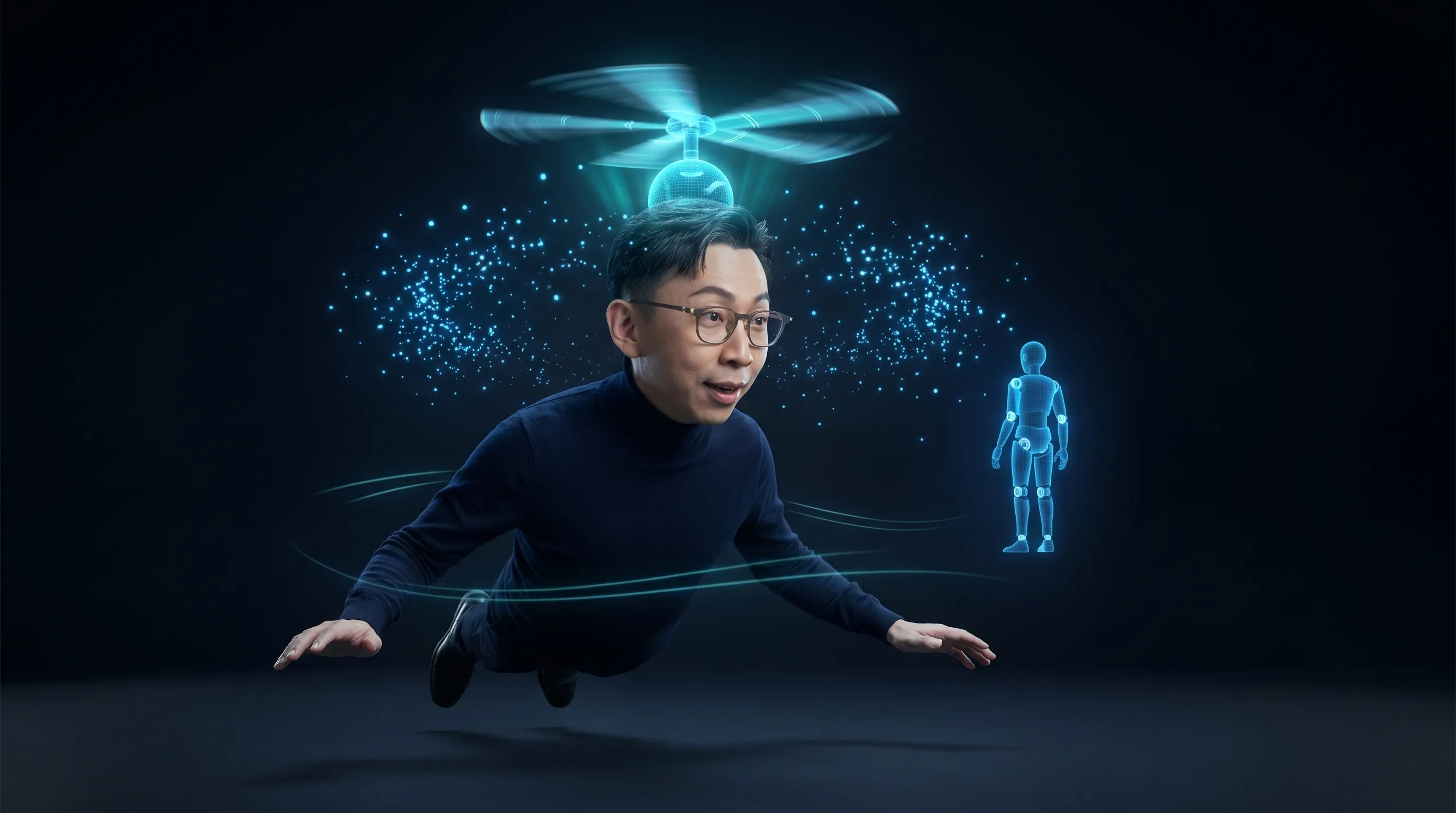
It's Not a Bamboo Copter — It's a Flying Carpet: The First "Flying iPhone" Could Be Made in Taiwan Within 10 Years

It’s Not a Bamboo Copter — It’s a Flying Carpet
The question: “If hundreds, thousands, even tens of thousands of drone motors became small enough and powerful enough, could you, in principle, build Doraemon’s bamboo copter and fly a person or a thing?”
That’s what a friend asked me at 2am one night in late May 2026.
I was about to say “no, can’t be done” — but I sat down and actually did the math. And the answer broke open the entire next 50 years of the robotics industry, right there in front of me.
🧮 First, the brutal physics: why the bamboo copter is impossible
Hover power has a very simple formula (Disc Loading / Momentum Theory):
- T = thrust (newtons)
- ρ = air density ≈ 1.225 kg/m³
- A = total rotor disc area
Let’s float a 70-kg human (686 N thrust). What does it take at different disc areas?
| Disc area | Hover power | For comparison |
|---|---|---|
| 0.05 m² (bamboo copter size) | 70 kW | A Porsche 911 at full output |
| 0.5 m² (backpack eVTOL) | 22 kW | A motorcycle |
| 2 m² (flying exoskeleton) | 11 kW | Still big |
| 10 m² (helicopter) | 5 kW | Close to real |
| 100 m² (huge rotor) | 1.6 kW | Hairdryer-class |
The pattern is brutal — the smaller A gets, the more power explodes.
A bamboo-copter-sized rig needs 70 kW continuous. That’s just to fly. You also need:
- A battery that delivers 35 kWh (3× heavier than you)
- A downwash of 270 km/h air (bystanders get blasted away)
- A rotor system with zero margin for failure (you don’t want your head removed)
In other words: shrinking and multiplying drone motors physically does not get you back to a bamboo copter.
💡 But I noticed something: maybe “actuator” was the wrong category all along
In my previous post (A Robot’s Elbow vs a Drone’s Motor), I argued that the brushless motor is the shared core component between drones and robot joints.
But after writing it, I rethought — the framing had a blind spot.
A friend pushed back:
“An actuator is more about ‘in-body actuation’ — like muscles, like robot joints.” “An ion thruster is a different family — ‘out-of-body actuation’ — that path may actually be the right one for future micro-flight.” “By the time we get there, it’s not a bamboo copter anymore — it’s Harry Potter’s flight magic.”
That stopped me cold. It’s a beautiful engineering taxonomy I had never heard before.
Let me unpack it:
🔬 Two kinds of actuation: inside the body vs outside the body
🦾 Path A: In-body actuation
This solves the problem: how does an object move itself? Examples:
- A human’s muscles (10¹⁹ molecular motors inside your body)
- A robot’s joints (1 brushless motor + 1 harmonic drive per joint)
- An octopus robot’s soft muscles (Dielectric Elastomer Actuators)
- A surgical robot’s end effectors
- Prostheses, exoskeletons
Physics: Direct contact + structural drive. You transmit force into the world through mechanical contact.
This path already has an industry — but Taiwan does not dominate it.
🌪️ Path B: Out-of-body actuation
This solves the problem: how does an object change position in space without mechanical contact? Examples:
- Ion thrusters: electric fields ionize air to push it
- Magnetic levitation: magnetic fields push objects
- Acoustic levitation: ultrasonic pressure fields
- Electrohydrodynamic (EHD) propulsion: MIT’s 2018 motorless plane
- Theoretical field-effect propulsion: completely contact-free drive
Physics: Force transmitted via a field. You interact with the environment through fields, and the world helps you push.
This path doesn’t yet have an industry — but it also doesn’t yet have a monopolist.
🥷 Path A status: who owns it?
I have to be honest about three things my last post left out:
🇯🇵 Japan’s Harmonic Drive Systems (HDS) — 60–70% global share of harmonic drives
- Founded 1970
- Long-time supplier to the Big Four industrial robot makers (ABB, KUKA, FANUC, Yaskawa)
- ~$5B market cap
- Moat: 50 years of customer qualification, precision machining know-how
🇰🇷 South Korea’s ROBOTIS — dominant in education and research
- Founded 1999
- Flagship product: the DYNAMIXEL smart servo
- “ROBOTIS” itself comes from the question “Robot is…?”
- Customers: MIT, CMU, KAIST, Univ. of Tokyo, Stanford, Boston Dynamics’ research platforms, ToddlerBot
- Korea’s humanoid-robot supply chain added $68 billion in market value this year alone (KED Global, May 2026)
- They don’t just sell parts — they sell an entire robotics OS
🇨🇳 China’s Shenzhen Damiao — de-facto standard in open-source / academia / early startups
- Founded 2019 (by ex-DJI engineers)
- Flagship DM-J series joint motor (same technology line as MIT’s Mini Cheetah)
- Price killer: DM-J4310 ≈ USD 110, same-class Maxon / HDS ≈ USD 500–2000
- Customers: OpenArm open-source robot arm ships bundled with Damiao motors; PiperX, Seeed Studio Wiki, all use them
- This is “the Arduino of the robotics world” — today’s students use Damiao for their senior projects; in 5 years their startups will still use Damiao
🇹🇼 Where’s Taiwan?
Honest answer — we’re just getting started on the “precision gear → harmonic drive” path. A few of our precision gear makers are sampling harmonic drives. A few power-tool gear makers are starting to win humanoid robot customers. A few servo motor makers are doing drone-to-robot crossover.
But we have nothing in the ROBOTIS-style “education / academia / open-source ecosystem” tier. Nothing in the Damiao-style “high cost-performance + international open-source distribution” tier. And we are not yet an HDS-tier critical chokepoint supplier either.
We have the muscle. We just don’t have a brand.
✨ Path B status: nobody has won yet
This path is more interesting because everyone is still in the lab.
MIT 2018: the first motorless plane
- Used Electrohydrodynamic (EHD / ion wind) propulsion
- No rotating parts
- 2.45 kg
- Flew 60 meters
- Thrust-to-weight ratio: terrible
But this was a proof-of-concept — it proved that “non-mechanical propulsion” is physically possible. From that day onward, “true flight magic” entered the countdown.
Other lines pushing the frontier
- Miniaturized ion-wind propulsion: MIT student teams trying to fit it into drones
- Magnetic levitation of humans: Japanese researchers floated mice using 17-tesla superconducting magnets
- Acoustic levitation grippers: can float small droplets, small components
- “Artificial anti-gravity”: purely theoretical, no experimental evidence yet
How far is “Harry-Potter-style flight”?
Honest answer: 50–80 years.
But here’s the thing — that 50–80-year horizon is the same order of magnitude as TSMC’s 1976 → 2026 journey.
🪄 From Bamboo Copter to Harry Potter: the real paradigm shift
Let’s revisit that table:
| Path | Physical mechanism | Stage | Key players |
|---|---|---|---|
| Big-rotor helicopter | Mechanical thrust | 100 years deployed | Bell, Sikorsky, Airbus |
| eVTOL (multi-rotor air taxi) | Mechanical thrust | Commercial since 2024 | Joby, Lilium, EHang |
| Flying exoskeleton | Mechanical + multi-rotor | 2030–2040 early | Jetpack Aviation, Gravity |
| Bamboo copter (10,000 micro-rotors) | Mechanical thrust | ❌ Physically inefficient, will never happen | — |
| Ion-thruster flight coat | Electric-field thrust | 2060–2080 early commercial | MIT, ?, ?, ? |
| Harry Potter flight magic | Field effect / gravity engineering | ? Completely unknown | ? |
The “bamboo copter” turns out to be a dead end — it can’t get back to its science-fiction form because it’s still mechanical contact propulsion.
But walking down the “ion-thruster flight coat” path, it stops being a bamboo copter and becomes real flight magic — your entire coat becomes the actuator, lifting you via fields, no downwash, no noise, no rotors, no severed heads.
That’s Harry Potter.
🇹🇼 Taiwan’s two 50-year paths
If the next 50 years are the back half of the Physical AI revolution, Taiwan has two entry points:
Path A: Catch up on the “in-body actuation” global supply chain
- There’s an industry, customers, capital, talent
- But competitors are tough (HDS 50 years, ROBOTIS 27, Damiao 7 but growing fast)
- Taiwan’s edges: precision-manufacturing depth, semiconductor crossover, geopolitical neutrality
- Opportunity: “the next harmonic drive” — but moving from “sampling” to “mass production” will take 10–20 years
Path B: Stake out the still-empty land of “out-of-body actuation”
- The whole world is still in the lab
- Lead players: MIT, Caltech, University of Tokyo, KAIST, ETH Zurich
- Taiwan’s advantage: no advantage — but no disadvantage either. The starting line is flat.
- Opportunity: Can Taiwan be the TSMC of ion-propulsion industry? Twenty years of R&D, thirty years of manufacturing. That’s a story truly belonging to Taiwan’s next generation.
🎯 Five concrete policy proposals
If we walk both paths simultaneously, what can government do?
Proposal 1: National Flagship Program for “In-Body Actuation”
Modeled on Taiwan’s old “Silicon Crystal Plan” that built the semiconductor industry — establish a “National Flagship Program for Robotic Actuators”, NT$30 billion over 5 years for harmonic drives, servo motors, torque sensors.
Proposal 2: A “ROBOTIS-tier” Taiwan robotics open-source platform
ROBOTIS doesn’t sell parts — it sells an entire ecosystem: hardware + SDK + textbooks + customer service + certification. Taiwan should build an officially-backed “Taiwan Robotics Open-Source Platform”. Start by penetrating high schools, universities, open-source communities. Goal: in 10 years, every maker on Earth recognizes “Made in Taiwan” joint motors.
Proposal 3: Forward-Looking Research Fund for “Out-of-Body Actuation”
National Science and Technology Council program supporting early-stage physics research in ion propulsion, magnetic levitation, EHD, etc. Budget doesn’t need to be big (NT$500M–1B per year), but long term — at least 30 years. Goal: one or two Taiwanese labs become global top-10 in this field.
Proposal 4: Amend the Government Procurement Act to allow robot showcase procurement
Hospitals, fire stations, eldercare, agriculture, education — all should procure local robots. Stop selecting only “cheapest / biggest brand / imported”. Germany, Japan, China, and Korea all have national robot showcase procurement programs. Taiwan needs one too.
Proposal 5: A National Robotics Testing Sandbox
Korea has one. China has one. Japan has one. Taiwan doesn’t. Pick a piece of land (an outer island, an abandoned airport, an industrial park). Open it freely to domestic and international robotics startups. Bundle with: robot insurance, certification, liability law.
⚠️ Required warning
This article is about 30–80 years.
This is not “tomorrow’s stock market”, nor “what to buy in the next 5 years”. This is a policy essay about the next generation of Taiwanese.
Science fiction isn’t conjured from nothing — 1865, Jules Verne wrote From the Earth to the Moon. 1969, humans walked on the moon. 1968, Arthur C. Clarke wrote about tablet computers in 2001: A Space Odyssey. 2010, iPad shipped. 2010, Iron Man gave us J.A.R.V.I.S. 2024, we have ChatGPT.
Science fiction is the 50-year spec sheet.
But equally — nothing guarantees that what’s in science fiction will arrive. Anti-gravity has no experimental evidence yet. Time travel violates the second law of thermodynamics. Telepathy violates causal information theory.
So this article should be read as a “thought experiment”, not as an “investment guide”.
But I do believe one thing:
A country that doesn’t think about the physics of 50 years from now, will only get to fight for the leftover orders of 50 years ago.
In 30 years, TSMC went from an obscure Taiwanese company to a global sacred mountain, proving that this island is very good at executing other people’s spec sheets.
For the next 50 years — do we dare try writing our own spec sheet?
Imagination, like capital, compounds when concentrated, balances when diversified.
What Taiwan lacks most today isn’t technology — it’s the courage to allocate a small slice of capital to 50 years from now.
— Ju-Chun KO (BaoBo) / Legislator
📌 Disclaimer
This article is a science policy / long-range industry speculation piece, NOT investment advice or financial analysis.
Concepts referenced — “out-of-body actuation”, “ion propulsion”, “flight magic” — are all at lab or theoretical-physics stage, and commercialization may be 30–80 years away. Readers should not treat any company or technology mentioned here as an investment target.
Companies referenced (including Japan’s Harmonic Drive Systems, South Korea’s ROBOTIS, China’s Shenzhen Damiao, etc.) are described purely as objective industry context, NOT as investment recommendations or negative judgments.
Readers seeking detail should do their own research, accept their own risk, and consult qualified financial advisors. Views are personal and do not represent the Legislative Yuan or the author’s political party.