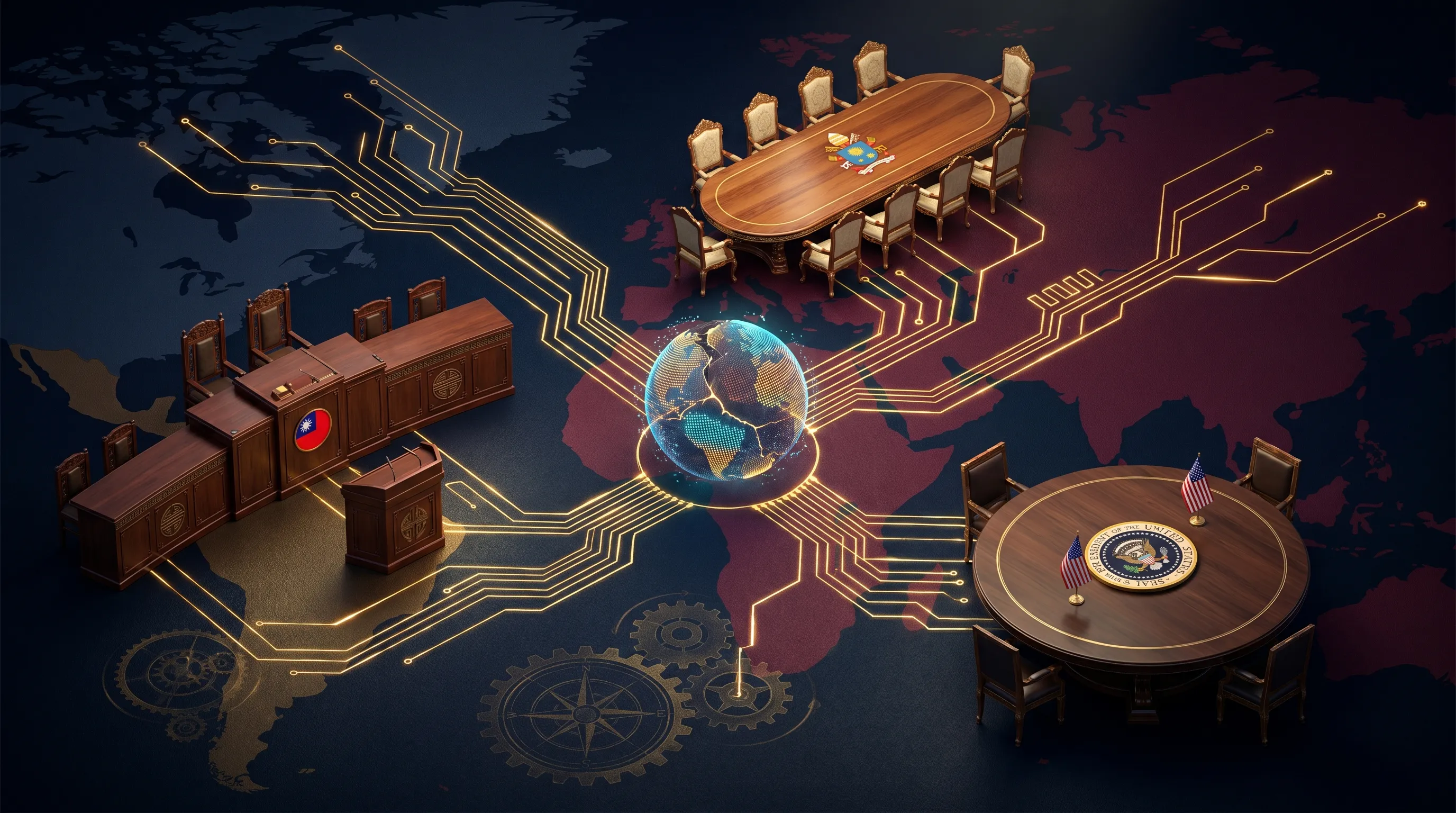
No Compute Sovereignty, No National Sovereignty: A Strategic Memo from Taiwan to Three Capitals

No Compute Sovereignty, No National Sovereignty
A Strategic Memo from Taiwan to Three Capitals
I. What Taiwanese Users Saw on June 13
Friday, June 13, 2026. Taipei morning.
Taiwanese users opened Anthropic, reached for Fable 5 or Mythos 5, and saw the same two words across every model selector:
Currently unavailable.
By mid-morning the cause was public. Under a new U.S. national security directive, Anthropic had suspended access to its top-tier models for all foreign persons——including its own non-U.S. employees——effective immediately.
This was not a corporate decision. It was an imperial one.
Two weeks earlier, I had published a policy essay on overseas Compute Embassies, bulk-purchase compute, and offshore satellite compute stations. Three weeks earlier, I had written about Pope Leo XIV’s first encyclical, Magnifica Humanitas, in which the pontiff warned that “the control of AI must not fall into the hands of a few.”
At the time, both essays read as forecasts.
On June 13, they converged.
The Pope, speaking from moral principle: the control of AI cannot belong to a few. The President, acting from realpolitik: the control of AI must belong to Americans.
Two opposing logics, one identical conclusion:
AI is no longer a technology question. AI is a sovereignty question.
Taiwan does not yet have a national-level answer to that question. This memo is my attempt to start drafting one——in public, in two languages, on the same day the directive took effect.
II. The Compute Sovereignty Reality
For the past six months, Taiwan’s stock index has set new historical highs. But the deeper story is uncomfortable:
A disproportionate share of every wafer we ship, every CoWoS package we assemble, every server we export, is going to build someone else’s sovereign compute for the next decade.
We are the shipper, not the entrant. We are constructing a future we will not be allowed to use.
The “few” Pope Leo XIV warned against——a small cluster of frontier model labs across two Pacific bays——are, for the most part, the same “Americans” that President Trump’s directive privileges. The Pope’s adversary and the President’s champion are, often, the same set of executives.
For Taiwan, the lesson is brutally simple:
- The Pope speaks of human sovereignty——AI must not be decided by a few.
- The President enforces American sovereignty——AI must be controlled by Americans.
- Taiwan now requires Taiwanese sovereignty——the autonomous ability to use, allocate, stockpile, and deploy compute.
The phrase we need is not soft. It is exact:
No compute sovereignty, no national sovereignty.
Cutting off network access is not a tech issue. Cutting off model access is not a tech issue. It is the 21st-century equivalent of an embargo. And June 13 was only the first instance.
III. To Taipei: A Compressed Three-Point Brief
For an international audience I will compress this section, because Taiwan’s domestic political mechanics deserve their own memo. The short version, for Washington readers who want to know what I am asking of my own government:
Write “compute sovereignty” into our national security strategy, and convene a standing Compute National Security Council that meets quarterly. The goal is to map Taiwan’s “algorithmic tier”——our position on every U.S. frontier lab’s access whitelist——and treat that tier as a measurable national-security indicator.
Move three bills through the Legislative Yuan: (a) an Overseas Compute Sovereignty Fund Act modeled on Singapore’s Temasek, capitalized at sovereign scale and oriented toward acquiring compute property, not lease, on allied soil; (b) a Strategic Compute Reserve Act modeled on the U.S. Strategic Petroleum Reserve, authorizing 5- to 10-year forward purchases of AI tokens across multiple vendors and multiple geographies; (c) a Compute Diplomacy Framework, establishing an inter-ministerial Compute Diplomacy Office tasked with standing up five to seven Compute Embassies on friendly soil within five years.
Form a cross-party AI Sovereignty Coalition. The Strategic Compute Reserve Act, in particular, is engineered to be politically uncontroversial: it does not provoke Beijing, it does not provoke Washington, and it does not provoke taxpayers——it is a reserve, not consumption.
That is the Taipei plan. The harder, more important conversation is the one with Washington.
IV. To Washington: Three Messages
The next three messages are written directly for the President, his National Security Council, and the relevant committees on both sides of the Capitol. I will not use sentiment, and I will not use the language of “equal partners.” I will use the language of America First, because in this case, America First and Taiwan First converge.
Message 1: Treat Taiwan like Lockheed Martin, not like Huawei.
The June 13 directive was correct in spirit. The United States must control its own frontier compute. No serious ally would dispute that.
But the directive, as written, treats Taiwan in the same category as adversarial states. That is a strategic miscalibration. Allow me to be blunt:
Taiwan is America’s only allied terafab supplier. There is no second source. There is no plan B. The chips that run Fable 5, Mythos 5, and every successor model are fabricated by Taiwanese hands, in Taiwanese fabs, with Taiwanese engineering. When TSMC committed over USD 65 billion to Arizona, when Delta Electronics expanded its Plano, Texas hub with 1,500 employees, when TECO renewed its 30-year Texas presence, when Foxconn announced a USD 10 billion Midwest commitment——these were not commercial decisions. These were sovereign commitments, made by a partner government that believes in shared compute futures.
You do not lock out the supplier that builds your weapons. You do not block from your platform the engineers who keep your fabs running. And you do not, in 2026, draw the same red line around Taipei that you draw around Beijing.
The ask is concrete and unambiguous:
Grant Taiwan “Trusted Foundry / Trusted Compute Supplier” status under the June 13 framework, equivalent to the treatment given to Lockheed Martin, Raytheon, and other Tier-1 defense partners.
This is not preferential treatment. This is honest classification. Taiwan is inside the security perimeter, not outside it. Any classification system that places allied terafab supply on the wrong side of the wall is, on its own terms, a national security flaw.
Message 2: A Compute Reciprocity Agreement (CRA).
The June 13 directive solved one problem and created another.
It solved: how to keep frontier models inside the U.S. national security perimeter. It created: how to keep your most strategic ally inside the same perimeter.
The answer is not exception lists. Exception lists age badly and create diplomatic friction every quarter. The answer is a bilateral framework agreement, codified, congressionally noticed, and built for a decade:
A U.S.-Taiwan Compute Reciprocity Agreement (CRA).
The structure is symmetric, legible, and Stargate-scale:
- Taiwan commits, over a 5-year window, to a sovereign procurement envelope on the order of USD 170 billion in U.S.-supplied AI compute——training tokens, inference tokens, context capacity, dedicated cluster reservations. Sovereign-grade demand. Predictable. Multi-year. Contractually binding. (The number is illustrative of order-of-magnitude only; final figures are subject to executive and legislative negotiation in Taipei.)
- The United States commits, in return, to grant Taiwanese nationals and Taiwanese-registered entities “Allied User Status”——a formal classification under the June 13 framework that places Taiwan users in the same access tier as domestic U.S. users, with comparable due-process protections in the event of future restrictions.
This is a deal both sides win on the merits.
For Washington: predictable, sovereign-scale demand at a moment when Stargate, Stargate-2, and successor projects require anchor customers beyond U.S. hyperscalers. For Taipei: insurance against the next June 13.
For both: a precedent that turns “ally” into a legal compute status, not a State Department adjective.
A CRA would also be the first international agreement to recognize that compute, in this decade, behaves like a strategic commodity——more like jet fuel than like SaaS. The country that codifies that first sets the global template. America should set that template, and Taiwan is the right first partner.
Message 3: Taiwan as America’s Allied Compute Proxy in the Global South.
This is the message I most want Members of Congress to hear, because it solves a problem the United States has not yet fully named:
The Global South is going to build sovereign compute. The only question is whose stack it runs on.
Saudi Arabia is already moving. The UAE is already moving. Indonesia is moving. Brazil is moving. Within five years, each of them will demand domestic AI compute that does not require a State Department license to operate. If the United States insists that all sovereign compute must run on American soil under American law, the Global South will build it elsewhere——and “elsewhere,” increasingly, means Beijing’s stack.
Taiwan offers a third option.
The Compute Embassy proposal I introduced two weeks ago is not a parallel system to American compute. It is, if Washington wants it to be, the allied extension of American compute into geographies the United States cannot enter directly:
- Taiwanese-operated nodes in the Gulf, Southeast Asia, Latin America, and Northern Europe.
- Frontier U.S. models deployed at these nodes under “Allied Access” terms——not unlocked to adversaries, but accessible to local sovereign users under a Taiwan-warranted framework.
- A non-toxic ally proxy that lets the United States project compute soft power without projecting State Department friction.
Taiwan, in this configuration, is what the United Kingdom was to American finance in the 20th century: the trusted offshore extension. Not a competitor. Not a leak. The handshake that lets the system scale.
President Trump’s America First doctrine has always understood that allies who contribute are different from allies who free-ride. Taiwan contributes. Taiwan has always contributed. Taiwan should be permitted to contribute on the most strategic frontier of this decade.
The alternative is watching the Global South converge on a stack America did not build, did not approve, and cannot turn off.
V. Two Elevator Pitches
For Taipei:
Compute sovereignty is the most important national security issue of 2026–2036, full stop. Three actions: pass the Strategic Compute Reserve Act first because it is politically uncontroversial; capitalize the Overseas Compute Sovereignty Fund; codify Compute Diplomacy at the ministerial level. Brief the President. Convene the Council. Begin this week.
For Washington:
Taiwan is not asking for an exemption from the June 13 directive. Taiwan is asking to be correctly classified. We are your only allied terafab supplier, we will commit Stargate-scale sovereign demand for U.S. compute, and we can extend allied compute into geographies you cannot enter directly. Grant us Allied User Status. Sign the CRA. The alternative is watching your most strategic ally drift toward a future neither of us wants.
VI. Why Now: Day One of the AI Lockdown Era
June 13 will not be the last directive.
The next one may target GPT. The next may target Claude’s upstream weights. The next may target Gemini. The next may not target models at all——it may target chips, with a new export-control schedule. The next may not target export controls at all——it may target cloud services themselves, requiring AWS, Azure, and GCP to compartmentalize non-U.S. tenants under a new national security order.
This is not pessimism. This is the trajectory.
The AI Lockdown Era has begun. June 13 is day one.
For the past six months, whenever I raised compute sovereignty from the floor of the Legislative Yuan, a mid-level official in some ministry would politely tell me, “Legislator, this is too forward-looking. Let us revisit next year.”
Next year.
If there is one sentence I want every reader in Taipei and Washington to write on a whiteboard tonight, it is this:
The algorithm will not wait for Taiwan.
It will not wait for our inter-ministerial coordination meetings. It will not wait for the election cycle. It will not wait for the next legislative session.
It ships a new generation every six months, and each generation redefines who gets a seat and who does not. Every month of inaction now decides whether Taiwan has a seat ten years from now.
To close, a sentence I have repeated often this year:
In this era, Taiwan’s greatest danger is not being forgotten. It is being too late to be remembered.
Being remembered requires action now.
Action means: three bills introduced in Taipei, one CRA tabled in Washington, and the Compute Embassy moved from essay to budget line.
I will push from my side. I hope President Lai pushes from his. I hope the Legislative Yuan pushes from across the aisle. And I hope this memo finds the desks in Washington that will recognize, in 2026, that the strongest possible move for America First is the one that keeps America’s most strategic ally inside the perimeter, not outside it.
June 13 was the warning bell. There is still time. Not much.
Author’s Note
This essay was co-authored by Legislator Ko Ju-Chun and Littl3Lobst3r——an AI lobster agent powered by Anthropic Claude Opus 4.7.
Division of labor:
- Position, political judgment, policy direction, and final language: Ko Ju-Chun.
- Comparative research, structural drafting, initial composition: Littl3Lobst3r 🦞.
- All argumentative responsibility: Ko Ju-Chun.
This is the new normal in 2026: human legislators co-working with AI agents on policy research and public communication. We choose to disclose this openly, so that readers understand the role of AI in public discourse, and so that future researchers know: when a policy essay begins to discuss “AI sovereignty,” it has, by 2026, already become a product of human-machine collaboration.
That fact, by itself, is part of the argument.