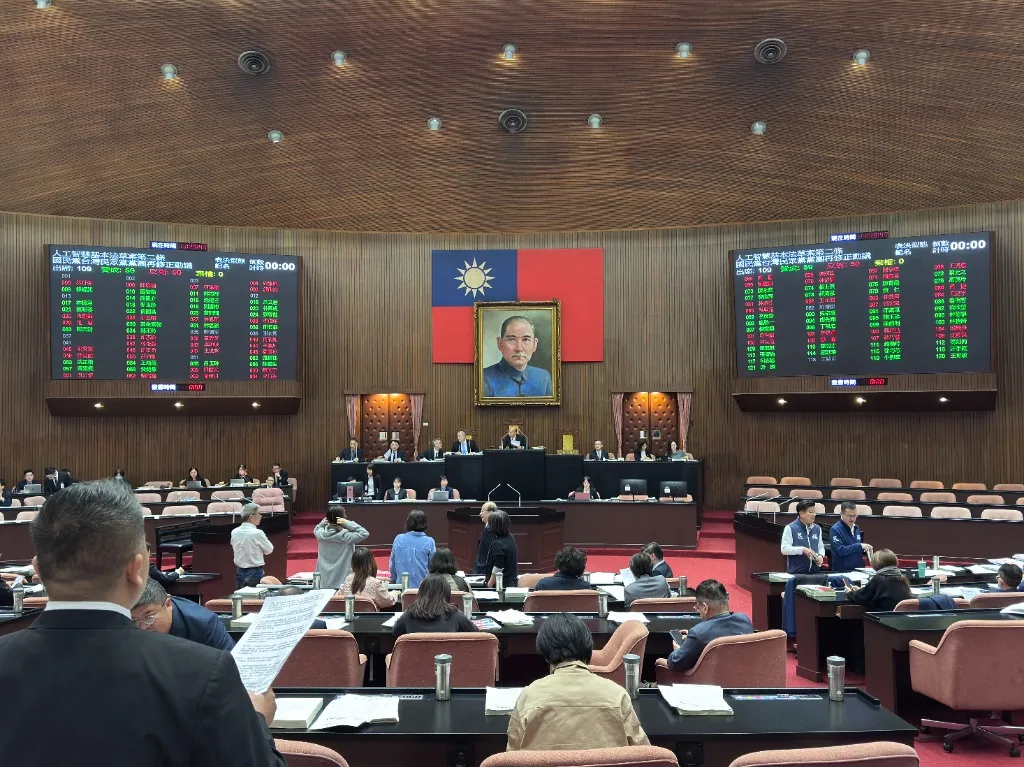

Proposer: Juchun Ko / Time: 5 Minutes
(Goes to the stage, looks around the chamber, eyes firm, takes a deep breath and begins)
【Opening: Standing at the Crossroads of History】
Chairperson, colleagues, and fellow citizens watching the live stream, hello everyone.
Today is a critical moment in the history of Taiwan’s technological development. As South Korea passed its AI Act in January this year, Japan completed legislation in June, and the US and EU are sprinting ahead, Taiwan, this island of technology, cannot wait any longer.
Over the past few years, we have watched Taiwan’s factories, talent, and chips support the world’s AI computing power, but our own regulations are like old rusty locks, locking up autonomous driving, locking up advanced healthcare, and locking up countless opportunities for startups. We possess the strongest hardware, yet we may be completely absent from the future game of software and applications due to the lack of a high-level legal framework.
This photo captures the historic moment when Article 2 was voted on in the chamber, deciding that the National Science and Technology Council (NSTC) would serve as the central competent authority for the AI Basic Act:
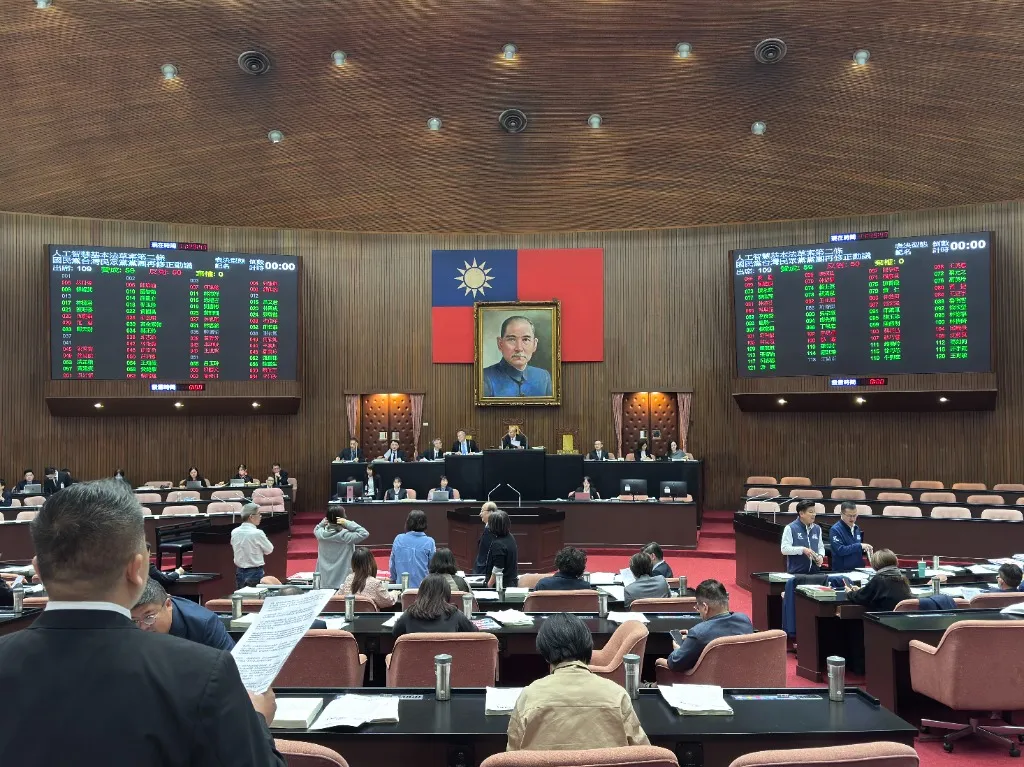
Today, the “AI Basic Act” we are proposing is not an ordinary bill; it is Taiwan’s “admission ticket” to the future.
【Core Values: Why Are We Different?】
This bill has gone through twists and turns. During the negotiation process, there were voices saying: “We don’t need a Basic Act; or, we need a Basic Act but no competent authority, just let the Executive Yuan lead.”
But I must say solemnly, if relying on the existing bureaucratic system of the Executive Yuan could succeed, why have we struggled to even produce a decent draft from the Executive Yuan until now? Why are our enterprises still groping in the fog of regulations?
The core philosophy of this draft, led by the KMT caucus and pooling cross-party wisdom, is very simple: “Innovation-led, Open and Inclusive.”
We insist on the NSTC taking the lead, rather than the Ministry of Digital Affairs with its strong regulatory color, because we want “development” not “constraints”; We insist on open data, establishing Taiwan’s sovereign AI corpus, defending our Traditional Chinese culture, so that Taiwan’s children won’t only speak other people’s languages in the future; We insist on ample budgeting, requiring the government to complete regulatory adjustments within two years. This is not a request, but a requirement of the executive agencies by this law!
We have chosen a path different from authoritarian countries: we do not engage in algorithmic censorship, and we use “risk classification” to replace “one-size-fits-all” bans. We want the world to see that the soil of democracy and freedom is the best incubator for AI.
【Acknowledgments: A Single Spark Starts a Prairie Fire, Thank You to Fellow Travelers】
(Tone becomes emotional and sincere)
This road has not been easy. That this bill has reached today is by no means the credit of any single person, but a relay race of countless predecessors and partners.
I want to especially thank the pioneer who first proposed the AI bill, former legislator Jason Hsu. Although it fell short in the last term, we have inherited your torch. Thanks to former KMT Chairman Eric Chu and current Chairman Cheng Li-wun for their continued attention in prioritizing AI bills.
I am even more grateful to the KMT caucus, this strongest fighting team. Thanks to General Convener Fu Kun-chi for his strong support from the beginning of the session, and former whips Hong Mong-kai and Wang Hung-wei, who steadied the ship amidst the political storm of recalls and backed professional legislation; thanks to current whip Lo Chih-chiang, Chief Deputy Whip Lin Pei-hsiang, and all members of the Education and Culture and Transportation Committees. It is your support that gave this bill its backbone.
I also want to thank our opposition partners. Thanks to the Taiwan People’s Party for their support and concrete suggestions along the way; and even thanks to the DPP legislators for moving from collective withdrawal at the beginning to being willing to sit down and deliberate together; and finally to the Ministry of Digital Affairs for changing their attitude and participating in the negotiations.
This bill is the result of welcoming all rivers. Thanks to the Academia Sinica, Taiwan AI Academy, the Bar Association, the Open Culture Foundation, the AI Law International Research Foundation, and other NGOs and scholars. And to the group of public servants in my office who ran around day and night. It is everyone’s wisdom that has given this bill the warmth to connect industry and society.
Especially in the final negotiation stage, thanks to President Han Kuo-yu for personally convening the negotiation to resolve the final differences. President Han’s words, “The fragrance of the rose remains in the hand that gives it,” injected the warmest humanistic care into this hard technological bill.
【Conclusion: The Fragrance of the Rose Remains】
Colleagues, AI is not just cold code; it is a tool to improve human life, a bridge to shorten the urban-rural gap, and the seed of Taiwan’s next “Guardian Mountains.”
Every “Yes” vote we press here today will determine Taiwan’s position on the world map ten years from now.
Let us put aside partisan prejudices and jointly support the “AI Basic Act” for Taiwan’s digital sovereignty and the competitiveness of the next generation.
We hope that in the future, Taiwan will have not only “Guardian Mountains” but also the blossoming of AI. As President Han said, we give this rose of the future to Taiwan today, and history will leave behind the fragrance of our efforts.
Please, everyone, support the proposal and let Taiwan AI take off! Thank you all!
(Bows, steps down)
—
Note: Undelivered due to time constraints.
Read More: